

Management Structure
Corporate Governance Structure
-
Kirin Holdings has adopted a pure holding company structure as a means of controlling its diverse and global business, which is centered on 3 domains such as Alcoholic Bevarage, Soft Drinks & Health Science, Phartmaceuticals. As a pure holding company, Kirin Holdings takes on the role of devising and implementing the Group's overall strategies, monitoring individual businesses, creating synergy, and responding to challenges surrounding sustainability through coordination across the Kirin Group.
-
The Kirin Group's individual companies conduct their business autonomously with a sense of speed, while maintaining close ties to the local consumers and other stakeholders. Kirin Holdings grants appropriate authority to match the strategic stages of individual Kirin Group companies and improves governance through the Board of Directors and the Boards of individual group companies by dispatching directors to those companies. Directors, Executive Officers, or their equivalents of Kirin Holdings serve concurrently as directors at the main companies in the Kirin Group.
-
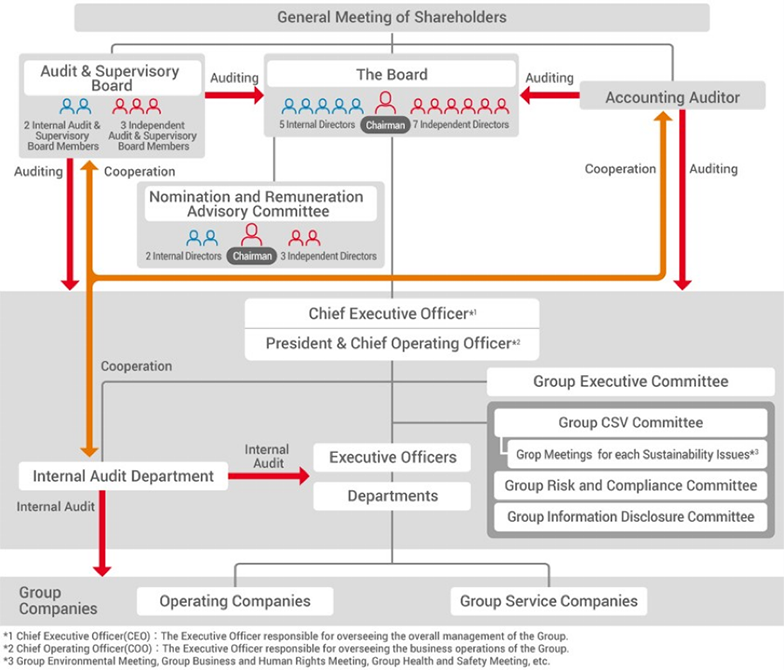
Kirin Holdings has adopted a Company with Audit & Supervisory Board system, and aims to maintain and improve on a highly transparent governance system for its stakeholders. The Board, which includes a number of Outside Directors, works closely with the Audit & Supervisory Board, which also includes a number of Outside Audit & Supervisory Board Members, and makes effective use of the statutory and other auditing function to take final decisions on important matters. At the same time, the Board endeavors to reinforce the monitoring function on management. Kirin Holdings has introduced an executive officer based system in order to implement strategies for each of its businesses and functions in an agile fashion and clarify executive responsibilities. The Board of Directors determines the scope of delegation to the Executive Officers based on their experience, track record, and expertise in their respective fields.
The Board of Directors
-
The Board of Directors is responsible for making decisions on important business operations and legal matters of the Group, supervising the directors' execution of their duties, and establishing an appropriate internal control system for the entire Group in cooperation with the Internal Audit Department and supervising its operation. In addition, the Board of Directors determines and approves long-term management concepts and annual business plans for the entire Group and major group companies, and monitors them regularly in light of changes in the business environment in an effort to maximize group corporate value.
-
Taking into account the knowledge, experience, skills and discernment that are necessary for turning the 2035 Vision into a reality, the Board shall be composed of the appropriate number of members, ensuring overall balance and diversity such as gender and internationality, etc. In addition, in order to build a highly transparent governance system and ensure the effectiveness of objective management supervision, the Company appoints a majority of independent outside directors. At least one of the independent outside directors has management experience at other companies.
-
Kirin Holdings has twelve (12) Directors, of whom seven (7) are Non-Executive Directors, and one of the Non-Executive Directors serve as Chairman of the Board.
-
The Board of Directors meeting is held regularly once a month, and is held as needed.
Frequency and attendance of Board meetings and attendance of individual members of the Board of Directors and the Audit & Supervisory Board
| 2023 | 2024 | 2025 | ||
|---|---|---|---|---|
| Number of meetings | 15 | 16 | 14 | |
| Attendance rate of Non-executive Directors | 95% | 98% | 96% | |
| Attendance rate of Audit & Supervisory Board members | 98% | 100% | 100% | |
| Attendance rate of individual members | ||||
| Executive Director | Yoshinori Isozaki | 100% | 100% | 100% |
| Takeshi Minakata | 100% | 100% | 100% | |
| Junko Tsuboi | 100% | 100% | 100% | |
| Toru Yoshimura | - | 100% | 100% | |
| Shinjiro Akieda | - | 100% | 100% | |
| Non-Executive Director | Hiroyuki Yanagi | 100% | 94% | 100% |
| Noriko Shiono | 100% | 100% | 100% | |
| Roderick Eddington | 80% | 100% | 86% | |
| Shinya Katanozaka | 92% | 100% | 93% | |
| Yoshiko Ando | 93% | 94% | 93% | |
| Shingo Konomoto | - | - | 100% | |
| Naoko Mikami | - | - | 100% | |
| Standing Audit & Supervisory Board Member | Shobu Nishitani | 100% | 100% | 100% |
| Toru Ishikura | 100% | 100% | 100% | |
| Audit & Supervisory Board Member | Kaoru Kashima | 100% | 100% | 100% |
| Kenichi Fujinawa | 100% | 100% | 100% | |
| Yoko Dochi | - | 100% | 100% | |
-
*This table shows the number of Board members as of December 31, 2025. For members appointed during the period, the attendance rate refers to the board of directors meetings held after their appointment.
-
*Extraordinary meetings of the Board held in writing are excluded from the number of meetings.
Evaluation of the Board of Director’s Effectiveness
-
Kirin Holdings defines the Board’s two primary functions as making important corporate decisions and providing supervisory oversight. We conduct an annual evaluation (November-December) of the Board operation and meeting content to both ensure those functions are being fulfilled and to continually improve its efficiency by identifying points to make the meetings more effective in the next fiscal year.
Fiscal 2025 discussion points
-
1.Discussions on “strengthening of corporate governance”
-
2.Discussions on “integrated strategy and risks” to realize appropriate risk-taking
-
3.Discussions on “digital ICT strategy” to accelerate value creation
Fiscal 2025 evaluations
Based on the results of the questionnaire survey and interviews, the Board of Directors has concluded that it is operating effectively, with its effectiveness sufficiently ensured to appropriately make decisions on matters of material importance to management and to supervise the execution of business.
Observations
-
1.Composition and operation of the Board
-
2.Development, execution and monitoring of strategies
-
3.Supervision of group governance and risk management
-
4.Supervision of decision-making on business acquisition/withdrawal, etc
-
5.Supervision of remuneration for officers and succession plan, etc
-
6.Thorough understanding and implementation of healthy corporate ethics and supervision thereof
-
7.Supervision of overall disclosures to stakeholders
-
8.Strengthening points to improve the effectiveness of the Board
Evaluation results
A survey conducted from October to November 2025 targeting all Directors of the Board and Audit & Supervisory Board Members, the Company also conducted interviews with the Chairman of the Board and Non-executive Directors, and performed analysis and evaluation. As a result of the analysis and evaluation, it was confirmed that there were no issues with the effectiveness of the Board. Based on the evaluation results and the current issues identified, improvement policies for the future were reported and discussed at the Board meeting held in January 2026. Furthermore, in order to further enhance the objectivity and transparency of the evaluation, the Company conducts an effectiveness evaluation with the cooperation of third-party advisors approximately once every three years. Based on the results of the most recent evaluation conducted in FY2024, the Company has confirmed that a high level of effectiveness is ensured.
Status of Initiatives for 2025 Improvement Points
| Points to improve in FY2025 | Specific Initiatives |
|---|---|
| Discussions regarding the "Business Portfolio Strategy" are underway, with the objective being the maximization of corporate value |
|
| Discussions on growth scenarios for each domain and business |
|
| Discussion on the "Digital ICT Strategy" to accelerate value creation through the advanced use of AI |
|
| Discussions on "Human Capital Strategy" to Foster a Culture of Challenge Among Employees and the Organization |
|
| Discussions on Effective Group Governance |
|
2026 Improvement Points
Based on the feedback received for each evaluation criterion in fiscal year 2025, as well as our assessment of future changes in the business environment, we have identified three key areas for improvement in fiscal year 2026. We will continue to strive to maintain and improve our effectiveness by setting the agenda under the leadership of the Chair, an independent non-executive director, and by improving our operations to facilitate broad-based discussions and decisive decision-making.
-
1.Financial and Stakeholder Strategy
-
2.Business Portfolio
-
3.Human Capital Strategy
Please note that details regarding operational improvements within the Secretariat are provided in section II. Status of Management Organization and Other Corporate Governance Structures Related to Management Decision-Making, Execution, and Supervision 2. Matters Related to Functions Such as Business Execution, Audit and Supervision, Nominations, and Determination of Remuneration (Overview of the Current Corporate Governance Structure).”
Audit & Supervisory Board
-
In keeping with its fiduciary responsibility toward shareholders, the Audit & Supervisory Board ensures the integrity of management with an eye to the Kirin Group's sustainable growth and the improvement of corporate value over the medium to long term, and acts to ensure in the common interests of the shareholders.
-
The Audit & Supervisory Board makes use of the ability of the Standing Audit & Supervisory Board Members to gather information within the Kirin Group and the independence of Audit & Supervisory Board Members. The Audit & Supervisory Board also develops a system to ensure that the audits carried out by each Audit & Supervisory Board Members are effective.
-
In order to intensify the provision of information to Non-Executive Directors, the Audit & Supervisory Board exchanges opinions with Non-Executive Directors and provide them with information obtained in the course of auditing.
-
Kirin Holdings has five (5) Audit & Supervisory Board Members, of whom two (2) are Standing Audit & Supervisory Board Members, and three (3) are Audit & Supervisory Board Members.
Frequency and attendance of Audit & Supervisory Board meetings and attendance of individual members of the Audit & Supervisory Board
| 2023 | 2024 | 2025 | ||
|---|---|---|---|---|
| Number of meetings | 19 | 18 | 14 | |
| Attendance rate of Audit & Supervisory Board members | 100% | 100% | 100% | |
| Attendance rate of individual members | ||||
| Standing Audit & Supervisory Board Member | Shobu Nishitani | 100% | 100% | 100% |
| Toru Ishikura | 100% | 100% | 100% | |
| Audit & Supervisory Board Member | Kaoru Kashima | 100% | 100% | 100% |
| Kenichi Fujinawa | 100% | 100% | 100% | |
| Yoko Dochi | - | 100% | 100% | |
-
*This table shows the number of Audit & Supervisory Board members as of December 31, 2025. For Audit & Supervisory Board members appointed during the period, the attendance rate refers to the Audit & Supervisory Board meetings held after their appointment.
Auditor's Audit
Kirin Holdings has adopted an audit system consisting of two (2) Standing Audit & Supervisory Board Members and three (3) Audit & Supervisory Board Members. Each Audit & Supervisory Board Member attends various internal important meetings, including the Board of Directors in accordance with the audit policy and audit plans which are defined by the Audit & Supervisory Board. In addition, the Company has a system in place to adequately audit the status of directors' execution of their duties, including audits of each division of the Company and on-site inspections of domestic and overseas group companies. For Group companies, the Auditors are assigned either full-time or part-time according to the scale of the company. The Auditors of Group companies coordinate closely with the Audit & Supervisory Board Members of Kirin Holdings to enhance the effectiveness of auditing.
Internal Audit
-
The Members of Internal Audit Department are concurrently responsible for conducting regular annual internal audits at Group companies, independently from the auditor’s audit, with regards to the Group’s significant risks and internal controls. The Internal Audit Department practically and efficiently conducts auditing for the Group overall, and by sharing the audit results of, and mutually supplementing the work of, the internal audit and the audit by the Audit & Supervisory Board. The Internal Audit Department Members coordinate with the Audit & Supervisory Board Members in setting and implementing auditing plans, coordinate with the full-time auditors of the key Group companies, and concurrently perform the role of part-time auditors in the Group companies, etc.
-
The Internal Audit Department, the Audit & Supervisory Board Members and an Independent Accounting Auditor also strive for mutual cooperation where they exchange information and opinions and consult each other as necessary. The Internal Audit Department and the Audit & Supervisory Board Members regularly exchange information and opinions with internal control-related departments, and the Accounting Auditor also conducts hearings with internal control-related departments as necessary, both thus implementing effective audits.
Relationship with the Independent Accounting Auditor and Internal Audit Department
-
The Audit & Supervisory Board develops a system capable of conducting thorough and appropriate auditing in coordination with the Independent Accounting Auditors and the Internal Audit Department.
-
The Audit & Supervisory Board verifies the independence and specialization of the Independent Accounting Auditors upon establishing evaluation criteria. The Audit & Supervisory Board holds regular interviews with the Independent Accounting Auditors, and requires the Independent Accounting Auditors to explain whether they are observing the necessary quality management criteria for carrying out accounting audits in an appropriate fashion.
Internal Control System
Kirin Holdings formulates basic policies on internal control systems as a system for ensuring the adequacy of Group operations at a meeting of the Board of Directors and strives to establish and operate appropriate systems for Group compliance, risk management, and ensuring the adequacy of financial reporting. In addition, the Company conducts annual inspections of the maintenance and operation of internal controls to confirm that the activities of the departments responsible for implementing internal controls are self-sustaining and functioning effectively and confirms the details of these inspections at Board meetings.
Group company governance and performance assessment
-
Kirin Holdings formulates and promotes Group strategy, monitors all Group businesses, and creates synergies across the Group. Each Kirin Group company is located close to its consumers and stakeholders and administers its operations autonomously and speedily with full authority to make business execution decisions tailored to their specific strategies. Kirin Holdings seats a director on each company’s Board of Directors to help maintain a high level of corporate governance.
-
Until 2021, return on assets (ROA) and earnings before income tax (EBIT) for each company, which is directly linked to return on invested capital (ROIC), were used as the performances evaluation indicators for operating companies, and ROIC and business profit are used as unified indicators from 2022.

Nomination & Remuneration Advisory Committee
-
The Nomination & Remuneration Advisory Committee has been set up to deal with the nomination and remuneration of Directors, Executive Officers, and Audit & Supervisory Board Members.
-
As an advisory body to the Board, the Committee discusses the following matters from an objective and fair perspective, and report to the Board of Directors. The matters that are discussed and reported on include the appointment/dismissal policy for Executive Directors, Executive Officers and Audit & Supervisory Board members, the proposed candidates for each position, the remuneration plan and level, the amount of remuneration and the succession plan for those responsible for the management of the Company.
-
The Nomination and Remuneration Advisory Committee shall, based on the delegation of the Board of Directors, determine the evaluation indices and targets for the individual performance evaluation, the evaluation results in accordance with the degree of achievement of those indices and targets, and the individual payment rates for the individual performance evaluation with respect to bonuses for the Company's directors (excluding non-executive directors) and executive officers.
-
The Committee is composed of five (5) Directors, consisting of two (2) Internal Directors and three (3) Non-Executive Directors, The committee chairperson is appointed out of the non-executive directors. The term of office is one (1) year.
-
The members of the committee in 2025 are as follows: Non-executive directors: Ms. Noriko Shiono (Chairperson), Mr. Shinya Katanozaka, Ms. Yoshiko Ando
Internal directors: Mr. Yoshinori Isozaki, Mr. Takeshi Minakata
Frequency and attendance of Nomination and Remuneration Advisory Committee meetings and attendance of individual members of the Board of Directors
| 2023 | 2024 | 2025 | ||
|---|---|---|---|---|
| Number of meetings | 13 | 13 | 12 | |
| Attendance rate of Committee members | 100% | 100% | 98% | |
| Attendance rate of individual members | ||||
| Executive Director | Yoshinori Isozaki | 100% | 100% | 100% |
| Takeshi Minakata | - | 100% | 100% | |
| - | Noriko Shiono | 100% | 100% | 100% |
| Yoshiko Ando | - | 100% | 100% | |
| Shinya Katanozaka | - | 100% | 100% | |
-
*This table shows the number of Committee members as of December 31, 2025. For Committee members appointed during the period, the attendance rate refers to the Nomination and Remuneration Advisory Committee meetings held after their appointment.
Advisory Bodies to the President
The following four bodies have been established as advisory bodies to the President.
1. Group Executive Committee
As an advisory body that assists and supports the President in making decisions, the Company strives to improve the quality of decision-making by flexibly holding meetings consisting of the Executive Officers, including the Senior Executive Officer & President and Executive Officers, Standing Audit & Supervisory Board members, professional advisors and others to discuss Group Executive Committee decisions on strategies and investments that have a major impact on the management of the Group.
2. Group CSV Committee
The Group CSV Committee deliberates the planning of Group CSV policies and strategies and monitors the progress status of CSV initiatives. The committee presents reports to the Board of Directors, which are reflected in the Group's overall strategy.
3. Group Risk and Compliance Committee
The Group Risk and Compliance Committee promotes and supervises risk management and the steadfast execution of compliance. The committee ensures the proper activation of response systems for crisis situations, such as by supporting information sharing and responses among Group companies in Japan and overseas.
4. The Group Information Disclosure Committee
The Group Information Disclosure Committee decides relating to information disclosure to stakeholders and investors, and improves management transparency through the promotion of timely, fair and impartial disclosure. The Chief Financial Officer is appointed as the committee chair. The heads of the department in charge attend the committee, and the standing audit & supervisory board members and the head of internal audit department serve as observers.