
Improving productivity Rely on digital technologies to do the tasks that do not require human intervention
Improving operational efficiency and creating value by utilizing both human resources and digitization
Improving operational efficiency and creating value by utilizing both human resources and digitization
Kirin is working to improve operational efficiency by relying on digital technologies to do the tasks that do not require human intervention.
To achieve this, it is important to clarify the roles of employees and digital technologies (AI, RPA, robotics) and to appropriately allocate tasks.
We will position digital technologies as a support role that complements employees’ intellectual activities. By doing this we will speed up operation and decision-making.
Also, employees will be in an environment where they can focus on tasks that only they can do, and the Company will shift human resources to creative tasks, such as learning about customers, developing products, and designing new businesses.
Case Study 1: Vendy
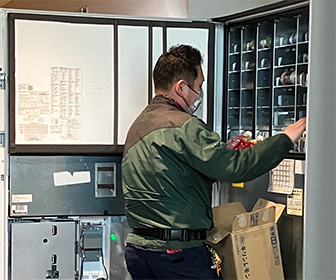
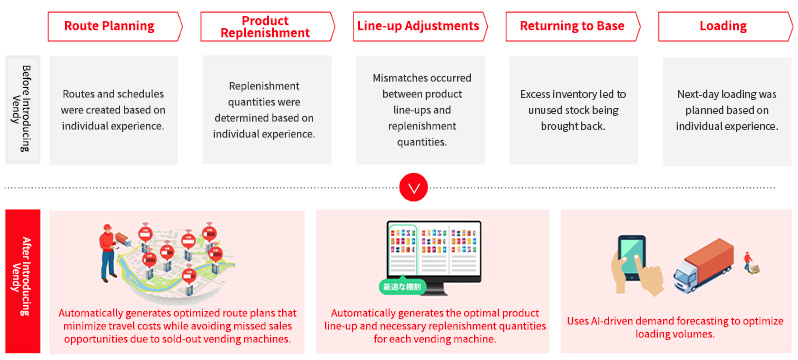
Kirin Beverage began using AI-powered vending machine operation service “Vendy” (provided by SoftBank Corp.) in October 2024.This service uses AI to analyze sales data, patrol cost, etc. It automatically suggests optimal product lineups, efficient patrol schedule and routes, and restocking amount.
“Vendy” is expected to reduce labor hours by about 10% and increase sales by about 5%.Furthermore, it can help brand development through product lineup suggestions, thus creating more satisfied customers.Vendy will address the vending machine industry’s labor shortage and waste.By initiating the use of Vendy ahead of the industry, we expect that Kirin Beverage will improve operational efficiency and service. Thus, we will achieve sustainable operations by having more time to develop new vending machine locations and training staff.The introduction of Vendy, an advanced system that makes full use of AI and big data, symbolizes Kirin Beverage's digital transformation.This is expected to have a wide range of effects, not only improving operational efficiency but also developing employees and cultivating new locations for vending machines.”
Case Study 2: Use of Generative AI
The Kirin Group is promoting organization-wide adoption of generative AI based on its generative AI utilization roadmap.
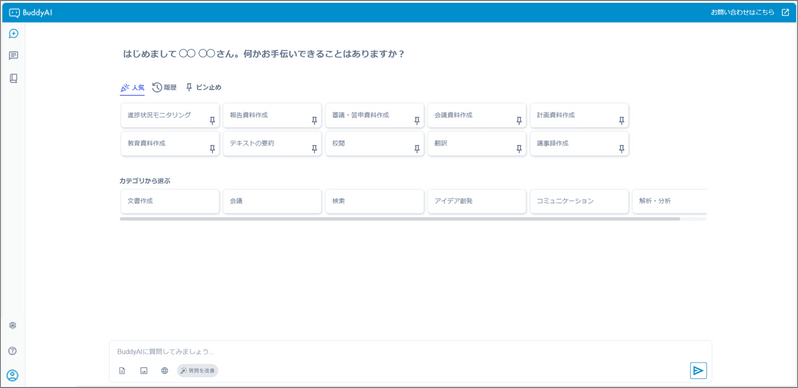
Following the results of “BuddyAI for Marketing,” which was first rolled out to the marketing division in November 2024, BuddyAI was expanded to approximately 15,000 domestic employees in May 2025. In 2025, in addition to BuddyAI, the Group advanced the introduction and adoption of multiple generative AI tools, resulting in an individual-level AI usage rate of over 70% across the Kirin Group. At Kirin Holdings’ head office, the usage rate reached nearly 100%, and in terms of productivity improvement, the AI-driven work substitution rate exceeded 10%*1.
The promotion of AI utilization is being carried out in conjunction with initiatives to strengthen foundational capabilities, including culture building, human resource development, and AI infrastructure. In terms of organizational structure, the Group has established and strengthened DX promotion organizations and advanced human resource development at major operating companies.*2 The “DX Dojo,” an employee digital skills enhancement program, has had a cumulative total of more than 5,100 participants in its main courses by 2025. In addition, a practical course that enables employees to learn AI utilization in a short period of time was newly launched last year, and by 2025 it had been taken more than 3,500 times.
-
*1The effect of operational efficiency improvement through the use of digital technologies and AI, evaluated as an equivalent amount relative to the total working hours of all employees.
-
*2DX-specialized organizations and dedicated personnel have been established mainly at Kirin Brewery Company, Limited and Kirin Beverage Company, Limited to create a structure responsible for promoting DX.