

Message from the Senior Executive Officer of CSV Strategy
To Shift CSV Management from Resonance to Action, Accelerate Value Creation Through the Integration of Financial and Non-Financial Aspects
From Kirin Group Vision 2027 (KV2027) to “Innovate2035!”
The external environment surrounding the Group is becoming structurally more challenging, with expanding geopolitical risks, the worsening impacts of climate change, the loss of biodiversity, growing attention to human rights and human capital, and changing social attitudes toward alcohol.
At the same time, the accelerating aging of populations and declining birth rates in mature markets, as well as ensuring the sustainability of regional economies and communities, have become urgent issues. Companies are increasingly required to respond in an integrated manner to both global and local challenges. These developments present risks for us, but also opportunities for long-term growth. I view this as a chance to leverage the strengths that Kirin has cultivated and to enhance our ability to create future value.
The Group has positioned CSV (Creating Shared Value) at the core of its corporate activities; however, this is not a special initiative newly introduced in recent years. At its foundation lies the philosophy of “Reverence for Life,” which we have upheld since our founding. As a company whose business is rooted in the blessings of nature, sincerely engaging with life and nature and returning value to society has always been the foundation of Kirin’s management. CSV is an articulation of this philosophy, structured as a strategy in the context of today’s business environment.
Looking back on FY2025, we have seen steady progress in the CSV Commitments set by each business. At the same time, through the revision of the Group Materiality Matrix (GMM), we have been able to evolve CSV in a way that more closely links it with our business strategy. Our initiatives to eliminate harmful alcohol consumption have made steady progress, our environmental initiatives have advanced, and we have implemented a number of activities that are well accepted by local communities. We have also established a business foundation in Health Science that contributes to addressing health issues. I believe that we have made meaningful progress toward our KV2027 vision of “becoming a global leader in CSV.”
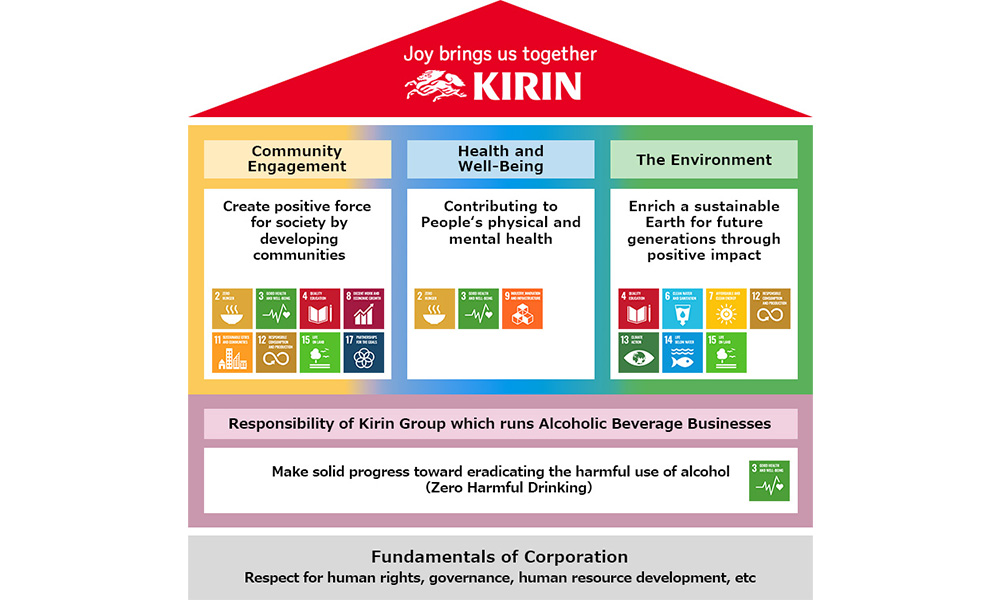
Building on this progress, under the Long-Term Vision “Innovate2035!,” we have revised our CSV Purpose to further evolve our CSV management. The key change I would like to emphasize is the clear positioning of “Health and Well-Being” as a central pillar of the CSV Purpose. With a focus on “contributing to people’s mental and physical well-being,” we will pursue growth that addresses both changing consumer values and social issues across our businesses in Alcoholic Beverages, Health Science and Non-alcoholic Beverages, and Pharmaceuticals. Under the new CSV Purpose, we will accelerate the creation of both economic and social value through our businesses in the areas of “Health and Well-Being,” “The Environment,” “Community Engagement,” and “Responsibility of Kirin Group which runs Alcoholic Beverage Businesses.”
In addition, in line with our shift toward a more agile approach to reviewing our strategies in response to changes in the external environment, we will transition to a framework for managing the progress of our CSV Commitments on a rolling three-year basis. It is important that these commitments are not an end in themselves, but are evolved into a management process for the continuous practice and improvement.
CSV Purpose
Evolution of CSV management and the practice of value creation
Particularly since the mid-2020s, the number of cases in which both social and economic value are created simultaneously has increased significantly across a wide range of areas, including Group companies. I personally feel that CSV is not limited to a concept, but has been steadily accumulated as tangible results.
For example, we established our “Environmental Vision 2050” at an early stage and have been advancing integrated initiatives to address environmental issues under the themes of “biological resources,” “water resources,” “containers and packaging,” and “climate change.” Our proactive efforts in TCFD-aligned disclosures, as well as in information disclosure on natural capital with a view toward TNFD, are grounded in our consistent recognition that environmental risks and opportunities are directly linked to future business value.
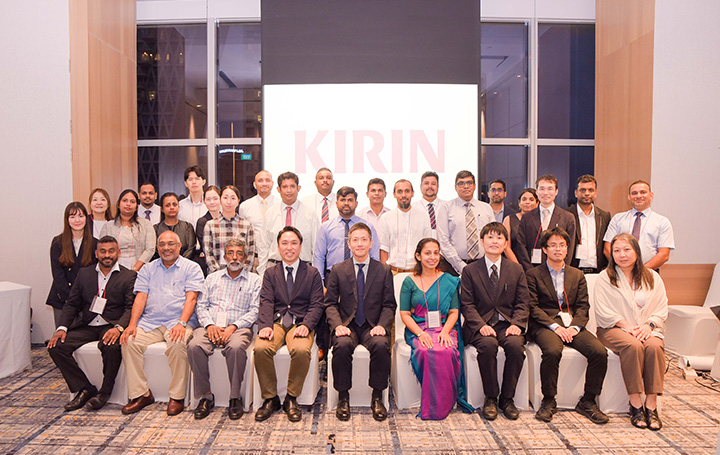
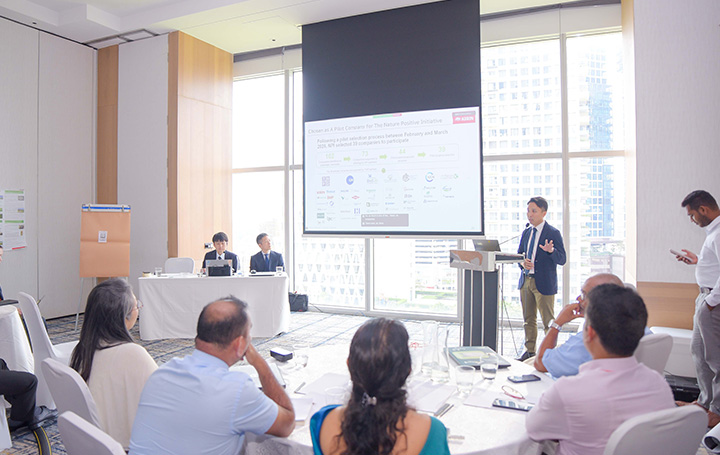
In 2025, we held the first “Kirin Forum” in Sri Lanka, the major raw material production area for Kirin Gogo-no-Kocha. This initiative, in collaboration with academia and international organizations, aims to lead the creation of social impact through co-creation with diverse partners. Building on our efforts since 2013 to support tea plantations and certification, we are not only accelerating the transition to regenerative agriculture that contributes to both climate change mitigation and biodiversity conservation, but also identifying and communicating social issues within local communities in a quantitative manner through well-being surveys of plantation workers. Through co-creation not only within the Group but also with global stakeholders, this initiative has evolved into a strategic effort that simultaneously enhances regional resilience and strengthens our business supply chain, and represents one example of value creation at the intersection of “The Environment x Community Engagement.”
Our nature-positive management through the wine business is also evolving to a new stage. Château Mercian Mariko Vineyard, operated by Mercian, has been certified by the Ministry of the Environment, Japan as “Nationally Certified Sustainably Managed Natural Sites”, and is becoming established as a model case that not only contributes to biodiversity restoration but also deepens relationships with local communities through volunteer programs at the vineyard. Jonohira Vineyard was certified as “Nationally Certified Sustainably Managed Natural Sites” in February 2025, followed by Tenguzawa Vineyard in March 2026. The health of natural capital is a critical factor that affects future cost structures and supply stability, and I position these initiatives as investments that enhance the long-term stability of business value. Through co-creation with local communities, these efforts aim to simultaneously regenerate natural capital and expand business value.
The practice of value creation through our products is also steadily expanding. In May 2024, Kirin Brewery launched KIRIN HYOKETSU mottainai as a limited-edition product using off-specification domestic fruits, and the series has since expanded to eight SKUs, including re-releases and distribution-limited offerings. The first release, Hamanashi, has been made a year-round product from March 2026 and is recognized both internally and externally as a symbolic example of CSV. In addition, under the “Let’s Transform Mottainai! to Tasty! Project,” which was launched in parallel, we have established a mechanism to utilize off-specification domestic fruits as ingredients and donate a portion of sales from the “mottainai” series to farmers. In 2025, this initiative was also extended to Kirin Gogo-no-Kocha, embedding CSV across a series of processes— from raw material procurement and product development to communication—thereby creating both social and economic value.
Similarly, in the Alcoholic Beverages Business, we launched Kirin Good Ale in October 2025, a year-round beer product developed under the theme of “creating connections among people for the future and revitalizing local communities across Japan.” In collaboration with local governments in all 47 prefectures, a portion of sales is used to support regional communities. In just four months after launch, the amount donated exceeded 28 million yen, equivalent to approximately 70% of the target for 2025–2026. We have also confirmed data showing that greater engagement with brand activities leads to higher purchase intent, demonstrating that products originating from efforts to address social issues can achieve both profitability and consumer support.
In the Health Science domain, we are expanding the value we provide to a wide range of consumers through initiatives such as deepening research in the anti-aging field in collaboration with FANCL and “Kirin Mutekids”, which focuses on children’s health management. Leveraging our strengths in Lactococcus lactis strain Plasma (LC-Plasma)—focused on the immune system as a commander—as well as our knowledge of the relationship between immune regulation and the gut environment, we are advancing Kirin’s unique value creation that spans Pharmaceuticals and Food & Beverages. This connects end-to-end, from research conducted in collaboration with medical institutions and academia to everyday consumption in the form of beverages, foods, and supplements. In particular, our direction of integrating Non-alcoholic Beverages with Health Science is an important step toward enhancing our ability to execute.
At the annual Kirin Group Awards, we recognize examples in which each and every employee engages in CSV through their daily work and, through ongoing challenges and ingenuity, translates these efforts into value creation. Last year, “Electric Salt,” developed through our new business creation program, and Blackmores’ AI-driven innovation pipeline initiative were selected among the top award winners. Both are examples of designing value from a consumer perspective, validating it through data and science, and connecting it to social implementation through brand strength and the power of gemba. We believe that enhancing this integrated capability will lead to shorter lead times for value creation, improved likelihood of success, and ultimately the realization of the Group’s vision.
What these initiatives have in common is the clarity of the causal relationship: (1) a structural understanding of social issues, (2) the integration of R&D, the power of gemba, and brand strength, and (3) the linkage to financial outcomes. It is important to view non-financial factors not as costs or requirements, but as investments that build competitive advantage, and to demonstrate their outcomes in terms of medium- to long-term cash flow generation.
CSV is not delivered by understanding alone—
moving to the next stage of integration and implementation
CSV management and value creation are steadily advancing, and our engagement survey shows that approximately 90% of employees resonate with CSV. In addition, indicators of implementation showed a statistically significant improvement year on year in FY2025, with a broader adoption of practices across functions and individuals involved in the value chain.
I believe that it is important not only to establish policies and frameworks, but also to steadily build trust with multiple stakeholders through dialogue that enhances the likelihood of execution at the gemba, as well as through continuous cycles of improvement.
Recently, I have come to recognize once again that the term “non-financial” can give rise to the misconception that it is somehow separate from financial matters. That is precisely why we need to view non-financial factors as “pre-financial,” linked to future financial outcomes, and incorporate them into management decision-making. The GMM and the CSV Purpose serve as a common language for this.
The year 2026 marks a major turning point toward the integration of financial and non-financial aspects. As General Manager of Corporate Strategy Department, I have also taken on responsibility for CSV since this spring, and will accelerate this integration.
The interests of stakeholders, including investors, are clearly expanding beyond financial information to non-financial information that cannot be fully captured through financial metrics alone. As disclosure standards such as ISSB and SSBJ become fully established and integrated evaluation of financial and non-financial aspects becomes the standard practice, what will determine corporate value is the consistency of an integrated narrative and the demonstration of competitive advantage from a long-term perspective.
Finally, my ambition for 2026 is clear.
I aim to turn empathy into action, connect action to results, and cycle those results into the next phase of investment and transformation. I also aim to embed CSV not as a “special initiative,” but as a “fundamental premise for decision-making” within management. We will further accumulate examples that successfully combine social and economic value across the areas of The Environment, Health and Well-Being, and Community Engagement, and continue to take on challenges as a Group toward the realization of our 2035 Vision.