
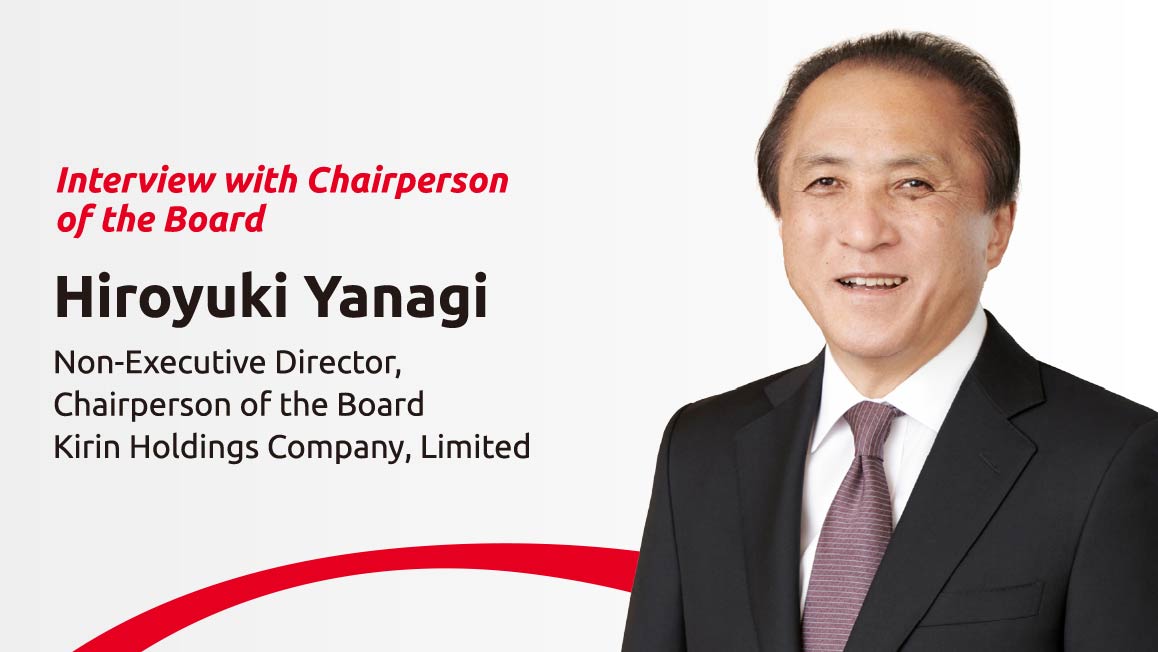
Interview with Chairperson of the Board
Enhancing Capital Efficiency and Increasing the Visibility of Transformation to Drive New Value Creation
Kirin Holdings is advancing initiatives to enhance the effectiveness of its Board of Directors in order to further increase corporate value.
We interviewed Mr. Hiroyuki Yanagi, Chairperson of the Board and a Non-Executive Director, about the Company’s management reforms and discussions regarding “Innovate2035!”
Strengths supporting Kirin’s capacity for transformation
—Since your appointment as a Non-Executive Director in March 2019, how do you view the Company’s management reforms and the role of the Board of Directors?
Since 2019, there have been several events that required major management decisions. One was the deviation of Standard Operating Procedures at Kyowa Hakko Bio that occurred between 2019 and 2020, which ultimately led to a fundamental structural reform of the company. Another was the withdrawal from Myanmar. Following the coup in 2021, this became an example of Kirin Holdings’ ability to make swift decisions. In addition, there were developments such as the acquisition of Blackmores and the move to make FANCL a wholly owned subsidiary.
In this way, as strategic initiatives and issue-resolution efforts progressed in parallel, internal management reforms also advanced significantly. In particular, the strengthening of business integration by function across the organization has been notable. In the past, I felt that this was an area where Kirin Holdings was relatively weak. However, for an organization to function effectively, both vertical and horizontal connections must be firmly established and well balanced. As a Non-Executive Director, I offered comments and advice on this point on several occasions, and today, it has been significantly strengthened across a wide range of areas, including marketing, R&D, quality assurance, production, and people and culture. Another notable aspect of this process was the strong commitment to learning from outside the Company. My impression of Kirin Holdings’ employees is that many are highly open and receptive. They demonstrate a strong willingness to study practices from other companies, and at exchange meetings with Yamaha Motor, where I previously served as Chairman, participants joined from a broad range of departments.
In addition, the Company’s decision-making in acquisitions and divestitures has been outstanding. Efforts to enhance the quality of acquisition decisions and the precision of PMI have evolved significantly in recent years, and valuable knowledge has been steadily accumulated through reviews at the Board of Directors. In particular, in acquisition processes, a well-defined grand design is established from the outset, followed by rigorous and objective discussions. Moreover, there is a strong commitment to approaching acquisitions as a unified company-wide effort. I was especially struck by this during the final Board resolution on the FANCL acquisition. On the day of the decision, members of the executive team each asked to speak briefly and shared their individual commitments regarding the acquisition. It was a moment that clearly reflected the Company’s unified, company-wide commitment to such initiatives. In many other companies, such efforts do not always become fully integrated, company-wide initiatives. In contrast, Kirin Holdings consistently demonstrates all three elements—grand design, objectivity, and a unified company-wide effort. These strengths serve as a key driving force behind the Company’s portfolio transformation.
Discussions at the Board of Directors have also deepened in reviewing the business portfolio that has been built.
What is most critical, however, is the approach to growth strategy. During the period of KV2027, the Company carried out the acquisitions of Blackmores and FANCL, and it is fair to say that these have brought the business portfolio closer to its ideal form—an achievement of considerable significance. Building on this foundation, under “Innovate2035!,” the Company has moved into the next phase of creating new value. Kirin Holdings is pursuing a highly distinctive management strategy spanning Alcoholic Beverages, Non-alcoholic Beverages through to Health Science and Pharmaceuticals. The strength of the current management team lies in its unwavering commitment to this strategic direction and its determination to see it through.
Board operations to enhance effectiveness
—You were appointed Chairperson of the Board in 2024. What are the key points you focus on in terms of board operations?
To enhance the effectiveness of the Board of Directors, I focus on four key aspects in managing its proceedings. First, I aim to ensure that the Board serves as a forum for high-level, strategic discussion. To that end, I ask that detailed questions be addressed in advance. Second, it is important for all members to engage in and share discussions on solving key issues. Since the Board brings together both internal and external members of Kirin Holdings, I expect the executive team to present well-focused materials—with clearly defined issues for discussion. Third, I emphasize the importance of making decisive decisions. The role of outside directors is not to act as a brake. Rather, our mission is to confirm the resolve of the executive team and support their decisions. Fourth, I would like discussions to be grounded in what I call the Four Realities. These are the actual place, the actual thing, the actual situation, and direct interaction with people. By focusing on these four perspectives, I aim to foster discussions that are firmly rooted in reality.
Discussions at the Board of Directors on the Long-Term Vision “Innovate2035!”
—What kind of discussions took place at the Board of Directors in formulating the Long-Term Vision “Innovate2035!”?
With regard to “Innovate2035!,” discussions between the executive team and the Board were conducted over a period of more than one year. I will explain the process at the Board by dividing it into seven stages. Stages one through six represent the process of discussion, while stage seven covers the ongoing issues that continue to be addressed.
Stage one was the “introduction.” From the outset, Representative Director of the Board, President & COO Minakata (hereafter, the COO) made a very clear statement of intent. It left a strong impression on me. He set out to validate Kirin’s portfolio management, particularly its decision to establish the Health Science domain. He also outlined a vision to develop both people and technology in order to build an innovative organizational capability that can surpass global competitors, and shared this vision among us.
In stage two, we worked on defining several key concepts. First, we established the KIRIN WAY, consisting of 3 Values and 6 Principles. Through repeated discussions to clarify our values and behavioral guidelines, the Principles in particular were gradually refined into their current form. Second, we engaged in a deeper exploration of what it means to “vitalize the world.” What does it truly mean to vitalize people? We aligned on the idea that it encompasses both mental and physical well-being, as well as connections among people and with society—elements that generate vitality and enable people to fully enjoy their lives.
In stage three, we confirmed at the Board that, since employees are the foundation of all management policies, it is essential to consider how to inspire and engage each individual.
In stage four, we discussed innovation. We defined innovation not as simply increasing the number of consumers, but as changing consumer behavior. I believe there was a strong sense of alignment within the Board regarding this definition. We agreed that this would be achieved through consumer-centric marketing and R&D that inspires excitement. To do so, it is essential to advance research and development that delivers clear differentiation and uniqueness capable of outperforming global competitors. While we will also pursue innovation in areas such as production, quality, and corporate functions, we believe that marketing and R&D—being the functions that directly create consumer value—should take the lead in driving innovation. Accordingly, we agreed to advance these two key initiatives.
In stage five, we discussed the “perspectives” of various stakeholders. From an employee perspective, we established a policy that emphasizes the importance of continuous, incremental improvements in daily work to drive behavioral change among each individual. From the perspectives of investors and society, we set a goal for “Innovate2035!” to enhance the visibility of value creation, building on the progress made under KV2027, which improved the visibility of the Company’s organizational structure.
The final stage, stage six, was as strongly memorable as stage one. Representative Director of the Board & CEO Isozaki (hereafter, the CEO) and COO Minakata expressed a clear commitment to “making the KIRIN WAY something embraced by all.” Although I have not observed Kirin Holdings over a very long period, it is possible that in the past, certain policies were set but did not sustain momentum or lost traction over time. This time, however, both management and employees have firmly committed to sharing a common purpose, supporting the KIRIN WAY as one organization, and striving to achieve their goals by increasing the number of employees with animal spirits. Kirin Group already has a high level of employee engagement, but there remains room for growth in gaining experience in overcoming constraints to achieve outcomes. By accumulating such experiences, the Company aims to foster more talent with, in a sense, instinctive bold ambition and rich sensitivity, driving further growth. Through this, Kirin will generate even more innovative ideas and products than before, thereby further enhancing the visibility of value creation.
Stage seven represents the ongoing challenge of how the Board will monitor and assess progress on these initiatives. We intend to closely track the autonomous growth of operating companies, the creation of innovation driven by marketing and R&D, and the execution of human capital strategy.
Discussions at the Board of Directors on “Innovate2035!” — 7 Stages
- Stage 1
- Statement of intent by COO Minakata
- Stage 2
- Definition of the 2035 Vision and KIRIN WAY
- Stage 3
- The importance of inspiring each individual employee
- Stage 4
- Definition of innovation
- Stage 5
- Enhancing the visibility of value creation from stakeholder perspectives
- Stage 6
- Statement of intent by CEO Isozaki and COO Minakata
- Stage 7
- How the Board of Directors will monitor progress going forward
─Could you share a message for our shareholders and investors?
At the Board of Directors, we aim to focus our discussions on enhancing corporate value. To that end, it is essential to improve capital efficiency and increase the visibility of corporate transformation.
While Kirin continues to demonstrate its traditional strengths— its unwavering commitment to craftsmanship and its strong execution capabilities at gemba—we are also seeing clear progress in strengthening functional integration, an area that was previously considered a weakness.
Looking ahead, it will be critical to ensure that a clear path to success through innovation is shared across the organization and that appropriate investments are made in line with this path. As various concrete initiatives begin to take shape, we will strive to ensure that our efforts are recognized and evaluated by shareholders and investors.