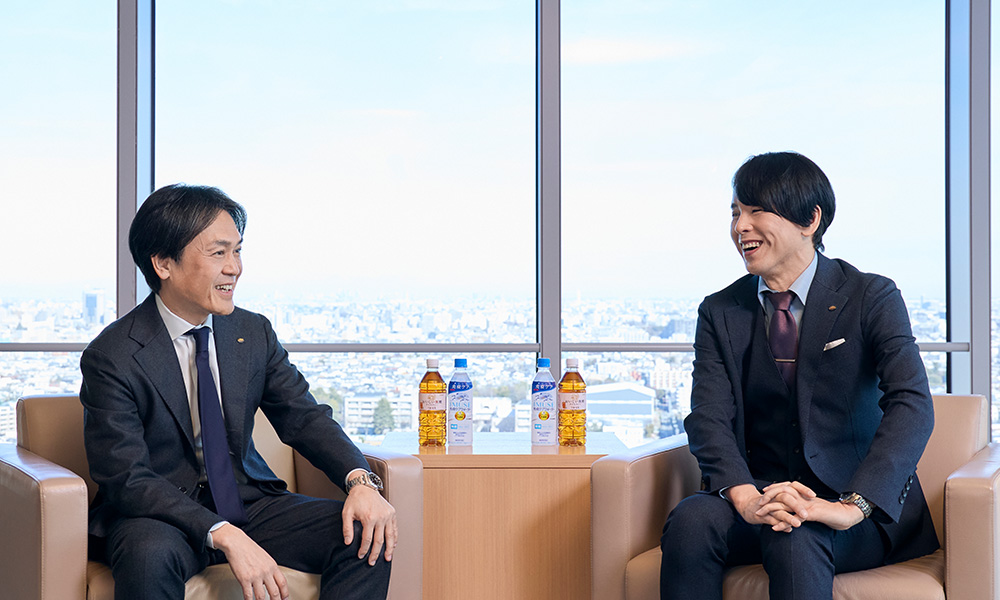
Dialogue Between the Officers in Charge of Marketing & Digital and R&D
Driving Innovation to Enhance Corporate Value
Creating corporate value through R&D and marketing
- Fujiwara:
- I apologize for starting from an R&D perspective, but the normalized operating profit of Kyowa Kirin, where I serve as a director, reached 102.3 billion yen in FY2025. The primary driver was Crysvita. In terms of revenue, it generated 216.4 billion yen, accounting for nearly 9% of the Kirin Group’s consolidated revenue. The anti-FGF23 antibody used in Crysvita traces back to research conducted during Kirin Brewery’s pharmaceutical business era. This evidences that the Kirin Group possesses R&D capabilities to create corporate value, as well as the ability to drive innovation. I myself originally conducted research on beer yeast, and it was in the Pharmaceutical Business that I learned the methodologies of immunological research. It is precisely because Kirin operates not only in Alcoholic Beverages and Non-alcoholic Beverages but also in Pharmaceuticals that I was able to discover LC-Plasma.
- Yamagata:
- Pharmaceuticals such as Crysvita, which address the treatment needs of patients with specific diseases, represent the core of health-related value. In contrast, when it comes to products like LC-Plasma, which help “maintain immune function in healthy individuals,” marketing plays a critical role.
- Extending healthy life expectancy is a major social challenge. However, it is not easy to encourage healthy individuals to recognize the need for such products. This may sound disrespectful to Mr. Fujiwara, the discoverer of LC-Plasma, but consumers do not go about their daily lives consciously thinking about the mechanisms by which LC-Plasma maintains immune function in the body.
- Fujiwara:
- That is exactly right. At the time, what we found most challenging was communicating the value of the technology. We visited institutional investors together with our IR team to explain LC-Plasma, and while it did generate interest, the candid response was whether it would truly translate into corporate value. Consumers, too, generally perceived it as just another type of lactic acid bacteria.
- Yamagata:
- I formally joined the LC-Plasma project around 2022. However, simply striving to communicate the excellence of a technology or idea does not have much meaning for consumers. The objective is not merely to explain the function of LC-Plasma. Rather, it is to help consumers feel that immunity may be important in their daily lives and to consider how we can encourage them to incorporate it into those lives. With this perspective in mind, I have been working on the initiative together with the team. Beyond the technology itself, what matters is how it is embedded into the everyday lives of consumers. I believe that true innovation emerges only when both of these elements come together.
- The same can be said of beer, Kirin’s founding business. It is true that beer sold in Japan because it tastes good. However, it achieved the position it holds today precisely because the “Sabuchan of Mikawaya”—a Japanese traditional home-delivery figure who regularly supplied beer to households—became embedded in everyday life.
- Fujiwara:
- I completely agree on the importance of delivering value to society. The true measure of a researcher lies in their ability to generate sound and scalable research. LC-Plasma is highly versatile, as it can deliver comparable benefits even in an inactivated form. I place great emphasis on fostering this kind of business mindset among our researchers.
Innovation unique to Kirin created via the combination of capabilities/businesses
- Fujiwara:
- It is important to define the path to market at an early stage in collaboration with marketing in order to translate innovation into corporate value. Currently, our R&D and marketing teams are working together in the field of anti-aging. Addressing aging is the ultimate health challenge for people and an area that Kirin has been researching for many years.
- Yamagata:
- In areas such as anti-aging, it is essential to have a structure in place that enables the entire Group to identify and nurture “seeds of innovation.” The Business Creation Department,* which successfully commercialized LC-Plasma, exemplifies this approach.
- Fujiwara:
- Yes, the Business Creation Department was established in 2016. Although it had fewer than ten members, it brought together talent from across the entire value chain—including myself as a developer, as well as colleagues from marketing, production, and sales. Because of this, we were able to rapidly and effectively integrate ideas into a single business.
- Yamagata:
- These successful experiences have indeed been carried forward as a strength of the Kirin Group. We should share them with the Board of Directors and management as Kirin’s unique ways of taking initiatives and the mechanisms behind them. By doing so, we can become a company that continuously generates one-of-a-kind innovation that cannot be replicated by others.
- Fujiwara:
- For example, in the consumer electronics industry, a single technology—namely the transistor—has been leveraged across a wide range of applications, such as televisions and radios, and through multiple channels to drive business expansion. I am convinced that this way of thinking—incorporating ideas across the value chain and designing offerings aligned with multiple customer touchpoints—is something only the Kirin Group can achieve, given its businesses in Alcoholic Beverages, Non-alcoholic Beverages and Health Science, and Pharmaceuticals.
Innovation co-creation with AI
- Yamagata:
- From the perspective of consumer touchpoints, AI will become increasingly integrated into their daily lives. Consumer purchasing behavior will shift from “buying products” to “buying experiences and solutions” with the advancement of AI.
- For example, when someone is injured, rather than first deciding on specific measures—such as bandages, disinfectants, or dressings—and then searching for products, consumers will instead seek one-stop solutions that address a more fundamental question: what should be done to treat the injury in the first place. As a manufacturer, we believe that we will be required not only to provide products that meet consumer needs, but also to create services and solutions that enable such experiences.
- Fujiwara:
- As consumers place greater emphasis on “experiences,” we need to develop effective approaches in areas such as health maintenance and prevention. Tea products with fat-reduction benefits became a hit because consumers could see measurable results on a scale. The immune visualization service for which we have already released a prototype is precisely the kind of technology needed to enable this.
- Yamagata:
- This applies not only to health-related products but also to enjoyment-driven products. By providing experiential value, visualizations, and the use of customer data, we expect further progress in the personalization of products and services. Against this backdrop, the importance of brands will continue to grow. A brand is not merely a label; it creates relationships through experiences. Going forward, brands will be increasingly expected to play a vital role in building relationships of “trust” with consumers by engaging with them in various forms—through companies, services, and technologies.
- Consumer touchpoints will therefore become even more critical. The Kirin Group has a wide range of products and brands—from beverages, including beer, to pharmaceuticals—that enable us to connect with diverse consumers, from children to the elderly, as well as patients and their families. To deepen relationships with consumers and leverage data through AI, direct consumer contact will become essential. FANCL, which has joined the Kirin Group, has a particular strength in direct consumer touchpoints and CRM.
- Fujiwara:
- FANCL is an operating company with strong capabilities not only in CRM but in R&D, and AI is dramatically accelerating the speed of research and development in this field as well. In the Pharmaceutical Business, it is generally said that it takes more than 15 years to bring a single product to market, making it the most time-intensive field of research. However, the use of AI is already advancing in this field, and we are applying these technologies to the Health Science domain, including the food sector. We are currently conducting joint research with Fujitsu Limited on reducing research timelines through the use of AI for drug discovery, and we are beginning to see results. In addition, systematic reviews required for the notification of Foods with Function Claims have traditionally involved reviewing a large number of academic papers. However, AI now enables this process to be carried out at an overwhelmingly faster pace. Patent applications, too, may no longer require significant human time and effort. Shortening R&D timelines is expected to contribute directly to enhanced corporate value.
- One of our key challenges going forward is how to leverage data that has not yet been fully utilized within the Kirin Group. For example, we have accumulated more than 100,000 data points from consumer research and component analysis of beer. Identifying the relevant factors through manual analysis would require significant time and cost. However, in December 2025, we launched a joint research initiative with Hitachi, Ltd., which has enabled us to predict consumer preferences. Of course, turning AI-generated outputs into beer that can actually be produced requires Kirin Brewery’s gemba capabilities—this is precisely the source of Kirin’s innovation. Applying AI to this “treasure trove” of data held by the Kirin Group will uncover new patterns and generate new insights.
The evolution of Kirin’s innovation driven by marketing and R&D
- Yamagata:
- As seen in the use of consumer research data you mentioned earlier, the most critical factor in generating innovation going forward will ultimately be a deep understanding of consumers. Marketing must play a central role in this. To respond to changes in consumer behavior and market dynamics driven by AI, it is essential to accurately capture what consumers truly need and to create technologies accordingly. While AI plays a critical role in this process, it is not an end in itself.
- Fujiwara:
- I agree that understanding consumers is the most important principle we should prioritize. In terms of delivering to consumers, across the Kirin Group, we have made significant progress in establishing the necessary systems and frameworks. I believe mission of R&D is to bring breakthrough solutions to this foundation.
- In Japan, there has been a tendency in recent years to overemphasize organizational strength, at the expense of individual breakthrough capability. However, the first step in truly innovative research originates from the curiosity of each individual researcher. Curiosity is something that cannot truly be shared with others. That is why each individual must think about the future and act with the aim of creating something that is genuinely meaningful. I call such “true researchers” star researchers. By cultivating more of these individuals, we will drive innovation at Kirin Holdings from the research front.