
[Soft drinks & Health science]
Lactococcus lactis Strain Plasma(LC-Plasma) Found to Inhibit SARS-CoV-2 and Influenza Virus Growth, with Findings Presented at an International Conference in Thailand
- CSV
- Research and Technology
November 4, 2025
Kirin Holdings Company, Limited
Please note that a correction has been made to the release issued on November 4, 2025.
We sincerely apologize for any inconvenience this may have caused.
Correction Detail
・Graph depicting dengue virus concentration in the “Reference Data” section
Before correction:Significant difference indicated by an asterisk (“*”)
After correction:Trend indicated by a hash mark (“#”)
・Graph annotation for dengue virus concentration in the “Reference Data” section
Before correction:No annotation
After correction:# : is not statistically significant; however, a trend is observed (p < 0.1)
November 19,2025
TOKYO, November 4, 2025 - Kirin Holdings Company, Limited (Kirin Holdings) has developed a proprietary material, “Lactococcus lactis Strain Plasma” (hereinafter referred to as LC-Plasma), through joint research with the Centre for Tropical Infectious Diseases Research and Education at the Universiti Malaya in Malaysia. The company has now demonstrated that LC-Plasma suppresses the proliferation of the influenza virus (H1N1) and SARS-CoV-2. These research findings were presented at the 20th Asia Pacific Congress of Clinical Microbiology and Infectious Diseases (APCCMI), held in Bangkok, Thailand, from November 2 to 4, 2025.
Our previous research has shown that stimulation of immune cells by LC-Plasma suppresses the proliferation of dengue virus (DENV), chikungunya virus (CHIKV), and Zika virus (ZIKV)*1. These viruses are pathogenic and are known to cause mosquito-borne tropical infectious diseases. The research also demonstrated suppression of rotavirus*2, which is recognized as the primary cause of acute severe gastroenteritis in infants and young children. When combined with the latest findings, these results confirm that LC-Plasma may be effective against at least six types of viruses.
These findings support the potential of LC-Plasma to prevent infection from multiple respiratory viruses. Since the global pandemic, viral outbreaks have become less predictable, and multiple viruses often circulate simultaneously. This highlights the growing need for new preventive approaches. We will continue to advance our immunological research and create value through evidence-based “Immune Care”*3, contributing to better health and overall well-being.
*1 Low ZX, et al, Microorganisms 12(11):2304, 2024.
*2 Jounai K, et al, Int Immunopharmacol 56:205-211, 2018.
*3 A healthy lifestyle that supports immune function, including a regular daily routine, balanced nutrition, adequate sleep, and moderate physical activity, is recommended.
Research Findings
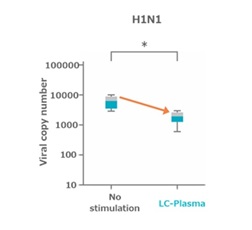
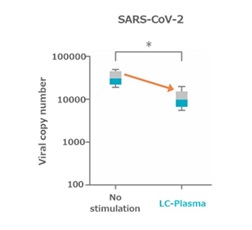
A concentration-dependent antiviral effect was observed when the culture supernatant from immune cells derived from healthy individuals, stimulated with LC-Plasma, was serially diluted and applied to cells infected with influenza virus (H1N1) and SARS-CoV-2.
-
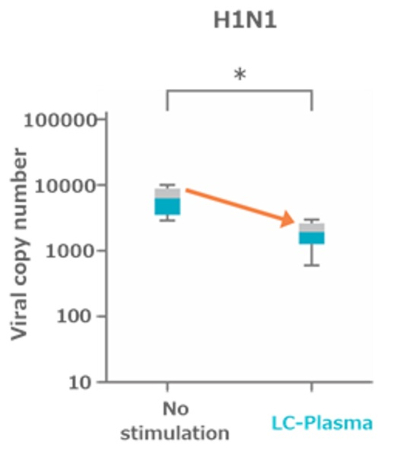
Figure 1: Influenza virus (H1N1)
-
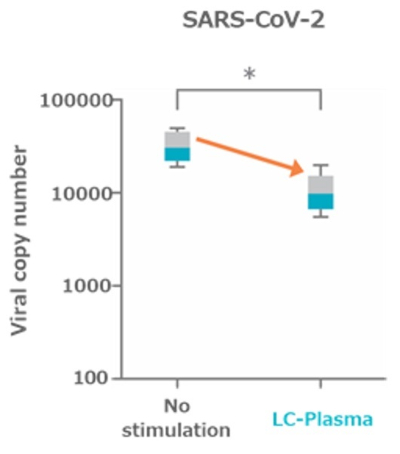
Figure 2: SARS-CoV-2
Implications
LC-Plasma is known to activate pDCs, a key regulator of immune responses, and induce IFN-α. These findings suggest the potential for virus-type-independent broad-spectrum infection prevention by suppressing the proliferation of a range of respiratory viruses, including influenza virus and SARS-CoV-2.
Future Prospects
Moving forward, we will verify the effects of LC-Plasma against other viruses of public health concern in Japan and internationally, further demonstrating its potential as a broad-spectrum antiviral agent.
About Kirin Holdings
Kirin Holdings Company, Limited is an international company that operates in the Food & Beverages domain (Food & Beverages businesses), Pharmaceuticals domain (Pharmaceuticals businesses), and Health Science domain (Health Science business), both in Japan and across the globe.
Kirin Holdings can trace its roots to Japan Brewery, which was established in 1885. Japan Brewery became Kirin Brewery in 1907. Since then, the company has expanded its business with fermentation and biotechnology as its core technologies, and entered the pharmaceutical business in the 1980s, all of which continue to be global growth centers. In 2007, Kirin Holdings was established as a pure holding company and is currently focusing on boosting its Health Science domain.
Under the Kirin Group Vision 2027 (KV 2027), a long-term management plan launched in 2019, the Kirin Group aims to become “A global leader in CSV*, creating value across our world of Food & Beverages to Pharmaceuticals”. Going forward, the Kirin Group will continue to leverage its strengths to create both social and economic value through its businesses, with the aim of achieving sustainable growth in corporate value.
* Creating Shared Value. Combined added value for consumers and society at large.
Reference Data
A paper published in Microorganisms (12(11):2304, 2024) titled The Antiviral Effects of Heat-Killed Lactococcus lactis Strain Plasma Against Dengue, Chikungunya, and Zika Viruses in Humans by Upregulating the IFN-α Signaling Pathway demonstrated that stimulation of immune cells by LC-Plasma was shown to have antiviral effects against dengue virus (DENV), chikungunya virus (CHIKV), and , which are known to cause mosquito-borne tropical infectious diseases.