

[Soft drinks & Health science]
Kirin and the University of Tokyo Achieve World’s First Confirmation that Cellular Senescence Reduces Nutrient Absorption Using Human iPS Cell-Derived Intestinal Organoids
- CSV
- Research and Technology
December 11, 2025
Kirin Holdings Company, Limited
TOKYO, December 11, 2025 - Kirin Holdings Company, Limited (Kirin Holdings) and the Graduate School of Agricultural and Life Sciences, The University of Tokyo have confirmed for the first time worldwide*1 that nutrient absorption declines in senescent intestinal epithelial cells, using a cellular senescence model*2 based on human iPS cell-derived small intestinal organoids*3. Furthermore, the research team identified that the underlying mechanism involves epithelial-mesenchymal transition (EMT), a process in which epithelial cells acquire mesenchymal characteristics. These findings were presented at the 48th Annual Meeting of the Molecular Biology Society of Japan, held in Yokohama from December 3 to 5, 2025.
In the context of a super-aged society, research on aging has become increasingly important. Intestinal aging, one of the health challenges associated with aging, is believed to contribute to reduced nutrient absorption in the elderly, leading to systemic health issues such as frailty. However, due to the difficulty of evaluating this phenomenon in humans, basic research and understanding have remained limited. Kirin Holdings and The University of Tokyo have focused on intestinal aging and have advanced joint research aimed at elucidating the biological mechanisms underlying cellular senescence.
The findings of this study, confirming the senescence-related decline in nutrient absorption by the intestinal epithelium and elucidating its mechanism, are considered highly significant. These findings contribute to a deeper understanding of intestinal aging and may facilitate the development of functional ingredients aimed at suppressing intestinal aging.
*1 Based on original research articles published in PubMed and Ichushi-Web (Survey conducted on November 26, 2025 by Knowledge Wire)
*2 A model developed in 2025 through joint research by Kirin and the University of Tokyo that replicates the characteristics of aging.
(Reference: Kirin and the University of Tokyo succeed in confirming the effectiveness of an anti-aging material using human iPS cell-derived small intestinal organoids for the first time in the world | 2025 | KIRIN - Kirin Holdings Company, Limited)
*3 Organoids are three-dimensional structures that mimic organs or tissues and are sometimes referred to as “artificial organs.”
Research Findings (Summary)
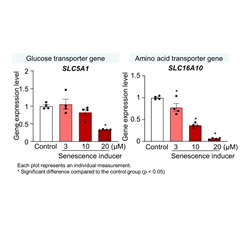
1. Induction of cellular senescence in human iPS cell-derived intestinal organoids resulted in decreased expression of genes related to nutrient absorption and metabolism, suggesting a decline in nutrient uptake associated with cellular senescence (Figure 1).
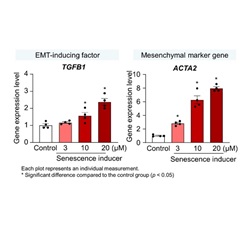
2. Increased expression of EMT-related genes and mesenchymal cell marker genes was observed, suggesting that cellular senescence promotes EMT (Figure 2).
-
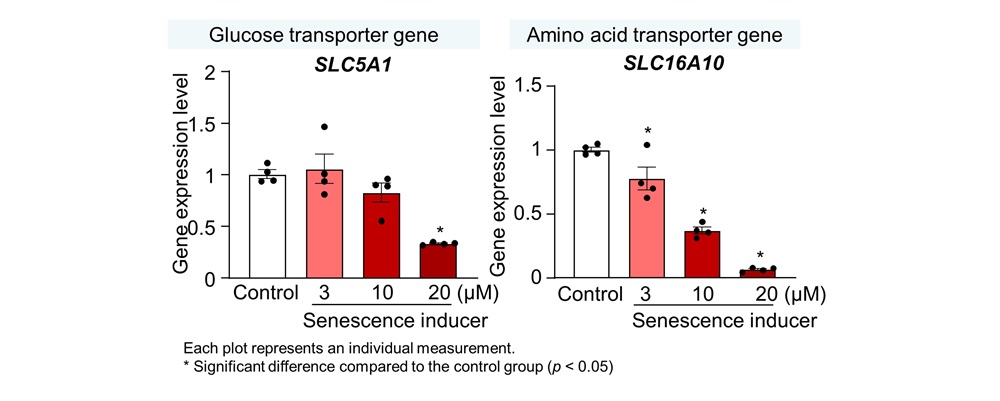
Figure 1. Decreased expression of genes related to nutrient absorption associated with cellular senescence
-
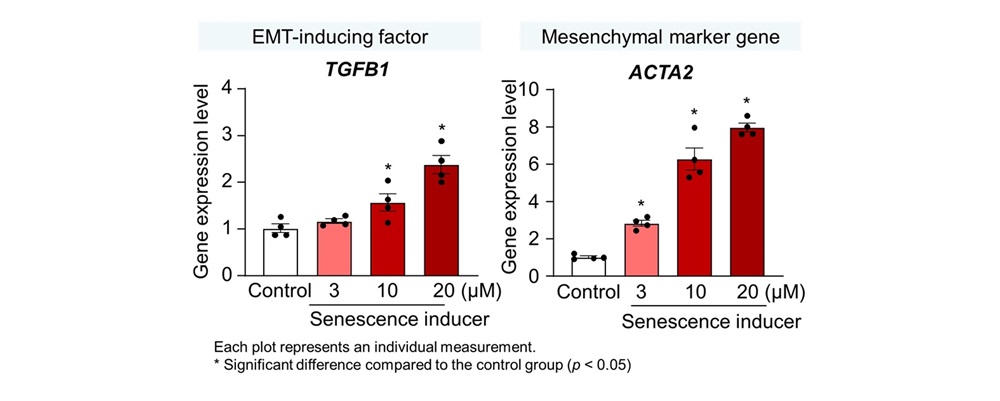
Figure 2. Increased expression of EMT-related genes associated with cellular senescence
Implications
We confirmed that cellular senescence reduces nutrient absorption in small intestinal epithelial cells. Furthermore, the findings suggest that this may be driven by EMT-induced loss of epithelial cell function.
Future Outlook
By elucidating the mechanisms underlying age-related intestinal dysfunction, we aim to develop new functional ingredients that help maintain intestinal health, which serves as a foundation for healthy longevity in the era of 100-year lifespans.
About Kirin Holdings
Kirin Holdings Company, Limited is an international company that operates in the Food & Beverages domain (Food & Beverages businesses), Pharmaceuticals domain (Pharmaceuticals businesses), and Health Science domain (Health Science business), both in Japan and across the globe.
Kirin Holdings can trace its roots to Japan Brewery, which was established in 1885. Japan Brewery became Kirin Brewery in 1907. Since then, the company has expanded its business with fermentation and biotechnology as its core technologies, and entered the pharmaceutical business in the 1980s, all of which continue to be global growth centers. In 2007, Kirin Holdings was established as a pure holding company and is currently focusing on boosting its Health Science domain.
Under the Kirin Group Vision 2027 (KV 2027), a long-term management plan launched in 2019, the Kirin Group aims to become “A global leader in CSV*, creating value across our world of Food & Beverages to Pharmaceuticals”. Going forward, the Kirin Group will continue to leverage its strengths to create both social and economic value through its businesses, with the aim of achieving sustainable growth in corporate value.
* Creating Shared Value. Combined added value for consumers and society at large.
Research Findings on Reduced Nutrient Absorption in a Cellular Senescence Model Using Human Small Intestinal Organoids
Background and Objectives
Intestinal aging is associated with systemic aging, and reduced nutrient absorption in particular is thought to contribute to malnutrition and frailty in the elderly. However, because direct evaluation of the intestines in elderly individuals is challenging, detailed elucidation of the mechanisms and the development of preventive strategies have remained limited. We previously established a cellular senescence model using human iPS cell-derived small intestinal organoids. In this study, we aimed to reproduce the age-related decline in nutrient absorption using this model and to elucidate its underlying mechanisms.
Research Method
Cellular senescence was induced in monolayer-cultured human small intestinal organoids by treatment with cisplatin, an anticancer drug. Gene expression related to nutrient absorption (e.g., sugars, amino acids) and epithelial-mesenchymal transition (EMT) was evaluated using quantitative PCR (qPCR).
Results
Gene expression related to nutrient absorption was compared between normal human intestinal organoids and senescent organoids. Induction of cellular senescence resulted in decreased expression of SLC5A1, a gene involved in glucose absorption, and SLC16A10, a gene involved in amino acid absorption (Figure 1). In addition, glucose uptake was significantly reduced in senescent organoids.
-
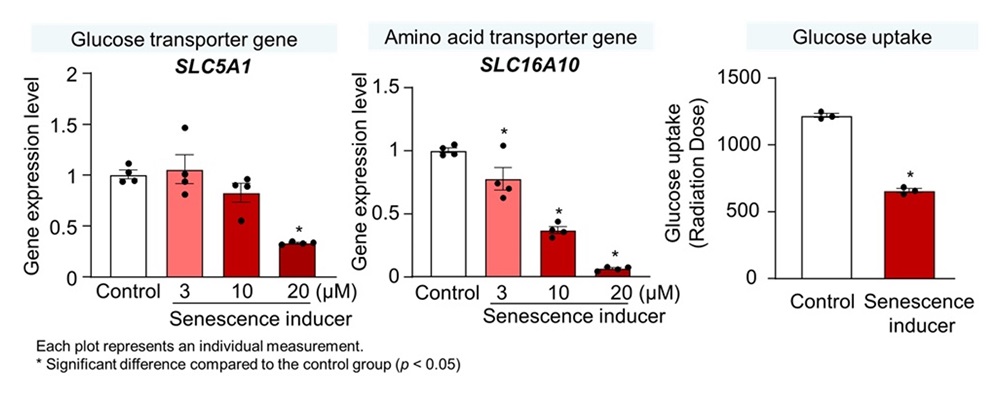
Figure 1. Decreased expression of genes related to nutrient absorption and reduced glucose uptake in human small intestinal organoids under a cellular senescence model
Further investigation of the mechanism underlying reduced nutrient absorption revealed increased expression of TGFB1, an EMT-inducing gene, as well as ACTA2 and CDH2, mesenchymal cell marker genes (Figure 2).
-
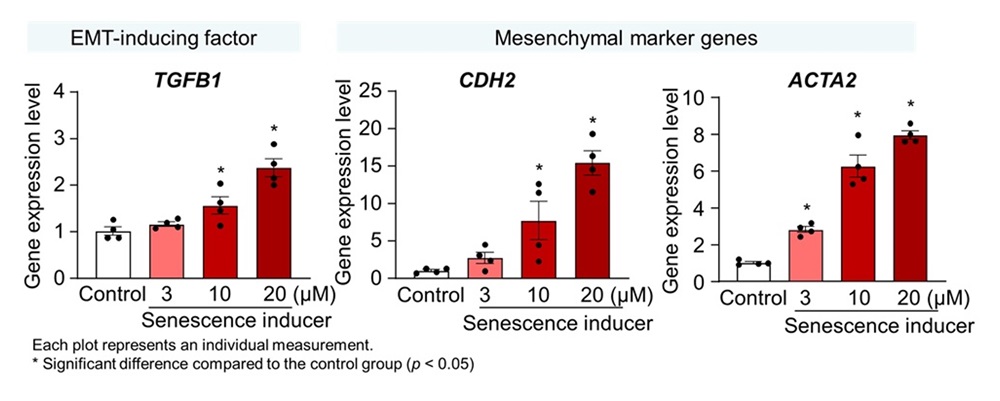
Figure 2. Increased expression of EMT markers in human small intestinal organoids under a cellular senescence model
Research Results
This study demonstrated a decline in nutrient absorption and induction of EMT in human small intestinal organoids under a cellular senescence model, suggesting that EMT may contribute to the loss of intestinal functions, including nutrient absorption. Future development of functional ingredients aimed at improving nutrient absorption and suppressing EMT is expected to help prevent intestinal aging.
What is Epithelial-Mesenchymal Transition (EMT)?
EMT is a biological process in which epithelial cells, which line surfaces such as the skin and intestinal tract, lose their epithelial characteristics and acquire mesenchymal traits. This transition weakens the barrier function that protects against external substances and instead confers mesenchymal features, including secretion of extracellular matrix components such as collagen and increased invasiveness. EMT plays an essential role in physiological processes like wound healing. However, excessive EMT is associated with pathological conditions, including tissue fibrosis and the progression of cancer cell invasion and metastasis, underscoring its role in disease.
GALLERY
-
Decreased expression of genes related to nutrient absorption associated with cellular senescence
-
Increased expression of EMT-related genes associated with cellular senescence
-
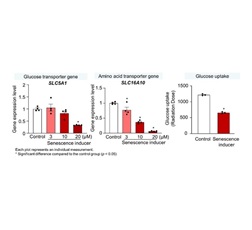
Decreased expression of genes related to nutrient absorption and reduced glucose uptake in human small intestinal organoids under a cellular senescence model
-
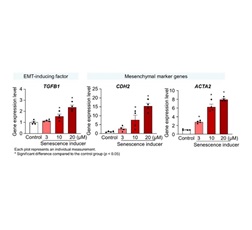
Increased expression of EMT markers in human small intestinal organoids under a cellular senescence model