

Kirin Holdings completes validation of SBTN Steps 1 and 2 and becomes the first company headquartered in the APAC region to disclose its efforts on the SBTN Target Tracker
- CSV
August 7, 2026
Kirin Holdings Company, Limited
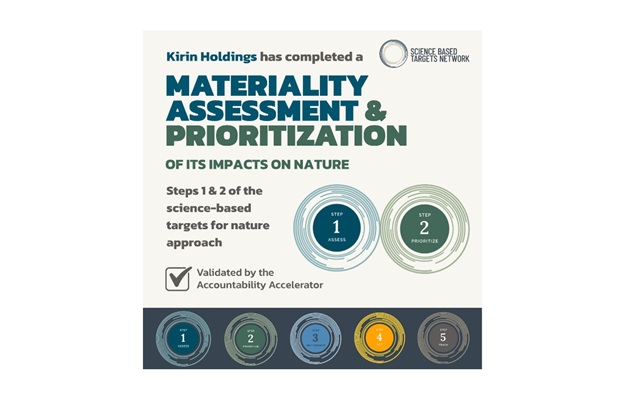
TOKYO, August 7, 2026 - Kirin Holdings Company, Limited (Kirin Holdings) has completed validation of Steps 1 and 2 of the SBTN*1 and has become the first company headquartered in the Asia-Pacific (APAC) region to disclose its efforts on the SBTN Target Tracker*2.
This work has been validated through the Accountability Accelerator, offering an independent stamp of approval, ensuring the analysis is in line with the best available science.By publicly disclosing priority locations and issues related to water resources, land use, and biological resources, the Company will further strengthen its efforts to address nature-related issues.
*1 Science Based Targets Network. A civil society and science-led initiative established by a group of NGOs in 2019. SBTN develops and provides methods and resources for setting science-based targets for a sustainable planet.
*2 A public database operated by SBTN that serves as a platform for companies to disclose their progress in assessing nature-related issues, prioritizing issues, and setting targets based on SBTN methodologies. Target tracker – Science Based Targets Network
Background
The Kirin Group conducts its business relying on nature’s bounty, including biological and water resources. For this reason, the Group has been considering target setting in line with SBTN Technical Guidance v1.2*3, which provides an integrated and science-based approach covering a broad range of natural systems, including freshwater, land, oceans, and biodiversity.
In this initiative, the Group evaluated and prioritized key issues related to water resources and land use across its upstream supply chain and manufacturing sites in accordance with the methodologies outlined in Step 1 (Assess) and Step 2 (Interpret &Prioritize) of the guidance.
In Step 1 (Assess), the Group identified key issues based on the impacts that economic activities within its direct operations and upstream supply chain have on nature. For direct operations, assessments focused on water use and water pollution. For the upstream supply chain, the Group compiled information on procured materials classified by SBTN as high-risk commodities and assessed water use, water pollution, soil pollution, land use, and land-use change in relevant regions.
In Step 2 (Interpret &Prioritize), the Group evaluated the condition of nature and biodiversity in each target region using multiple indicators, ranked locations based on scoring results, and identified priority river basins and regions where targets should be established.
*3 Guidance released by SBTN in September 2025: SBTN-Step-1-and-2-Validation-Requirements-and-Recommendations-v1.2.pdf
Outcomes of This Initiative and the Road Ahead
Through Steps 1 and 2, the Group was able to reconfirm priority locations and issues through a scientific approach. It also confirmed that regions and issues where actions had already been advanced, including Sri Lanka, a key tea-leaf sourcing region, and Australia and the United States, where water stress is high, are supported by scientific evidence.
As a company whose business relies on nature’s bounty, including biological and water resources, the Kirin Group will continue to advance its efforts based on guidance such as SBTN. In particular, the Group plans to continue to consider the setting of specific targets under Step 3 and contribute to initiatives related to measuring the “state of nature” under Step 5.
Overview of Key Initiatives in Priority Areas
The following are examples of initiatives already underway in regions identified through Steps 1 and 2 as priorities for the Kirin Group.
Initiatives to Address Natural Capital in Sri Lanka, a Tea-Leaf Producing Region*4
Sri Lanka is a major source of tea leaves used in Kirin Gogo-no-Kocha(bottled tea). Through Steps 1 and 2, the region was identified as requiring actions related to water use, water quality, and land management. Climate change impacts, water pollution, and land-related challenges are having serious effects on local communities, tea producers, and wildlife habitats.
For more than 10 years, the Kirin Group has identified its sourcing plantations and addressed environmental and social issues to support sustainable business development. Specific actions include promoting regenerative agricultural practices through support for Rainforest Alliance certification and implementing water source conservation activities*5. In 2025, the Group collected scientific data from tea plantations and quantitatively assessed environmental impacts*6.
*4 Tea Leaves | Sustainable development of related communities | KIRIN - Kirin Holdings Company, Limited
*5 Water Resources | The Environment | KIRIN - Kirin Holdings Company, Limited
*6 Kirin Holdings and the University of Tokyo Quantitatively Assess the Environmental Status of Sri Lankan Tea Plantations | 2025 | KIRIN - Kirin Holdings Company, Limited
Water Risk Mitigation Initiatives at Lion Manufacturing Sites*7
Lion Pty Ltd, which operates the Kirin Group’s alcoholic beverages business in Oceania, was identified through Steps 1 and 2 as requiring measures related to water use. In the region, severe water stress*8 driven by factors such as climate change is significantly affecting local communities and wildlife.
To address this challenge, Lion has constructed and expanded facilities that treat and recycle water used at the Tooheys and Castlemaine breweries, both located in areas experiencing high water stress*9. These initiatives have significantly reduced water consumption and helped secure water resources that can be used by local communities and other industries, thereby contributing to regional water resource management.
*7 Refers to various water-related risks, including physical risks such as water scarcity and flooding, and reputational risks.
*8 Water scarcity.
*9 Reverse Osmosis (RO) Water Recycling Plants. Water Resources | The Environment | KIRIN - Kirin Holdings Company, Limited
Water Risk Mitigation Initiatives at New Belgium Brewing
Fort Collins, a brewing site operated by New Belgium Brewing, which manages the Kirin Group’s U.S. craft beer business, was also identified through Steps 1 and 2 as requiring measures related to water use.
The region faces significant water challenges due to climate change, wildfires, and population growth, affecting both local communities and wildlife habitats. New Belgium Brewing has implemented water conservation measures within its brewery and supports efforts to address water resource issues through forest and wetland conservation near water source areas.
In 2025, New Belgium Brewing also participated in a TNFD Nature Transition Plan pilot program*10 focused on this brewery to help the Kirin Group explore pathways toward a nature-positive transition.
*10 Participation in the TNFD Nature Transition Plan Pilot Programme Developing a Nature Transition Plan for New Belgium Brewing's High Water-Risk Brewery | 2025 | KIRIN - Kirin Holdings Company, Limited
The Kirin Group conducts its business activities using nature’s blessings as raw materials and leveraging the power and wisdom of nature.
In addressing complex and interrelated environmental issues such as biological resources, water resources, packaging, and climate change, the Kirin Group will advance initiatives that create a “positive impact” on both nature and people from an integrated perspective.
The Group will also share its commitment to passing on the blessings of a rich planet to future generations with all stakeholders involved across the value chain.
For Reference
Kirin Group Environmental Vision 2050
Kirin Group's Environmental Vision 2050 | The Environment | KIRIN - Kirin Holdings Company, Limited
Kirin Group Environmental Report 2026
Kirin Group Environmental Report | Sustainability Information | KIRIN - Kirin Holdings Company, Limited
About Kirin Holdings
Kirin Holdings Company, Limited is a global company operating across three core business domains spanning Alcoholic Beverages, Non-alcoholic Beverages & Health Science, and Pharmaceuticals. The company traces its roots to Japan Brewery, established in 1885, which later became Kirin Brewery in 1907. Since then, Kirin has expanded its business operations by leveraging fermentation and biotechnology as core strengths. The company entered the pharmaceutical field in the 1980s, which has since grown into a global business. In 2007, the company transitioned to a pure holding company structure as Kirin Holdings, and it is now strengthening its Non-alcoholic Beverages & Health Science domain.
Under its long-term vision “Innovate2035!”, the Kirin Group is focused on creating value that encourage behavioral change among consumers and patients, creating new lifestyle habits in the areas of food and health. With a unique business portfolio spanning Alcoholic Beverages, Non-alcoholic Beverages & Health Science, and Pharmaceuticals, the Group will further expand group-wide initiatives that support both mental and physical well-being.
The Kirin Group will continue to advance innovation through the combined strength of its people and technology, creating both social and economic value as a global leader in CSV*, while pursuing sustainable, long-term growth in corporate value.
* Creating Shared Value. combined added value for consumers as well as for society at large