
[Soft drinks & Health science]
Kirin and JSW Successfully Demonstrate Alkaline Depolymerization Technology for PET Using Twin Screw Extruder TEX αⅢ series
Achieving over 95% depolymerization and advancing practical application of PET chemical recycling
- CSV
- Research and Technology
September 2, 2026
Kirin Holdings Company, Limited
∙ Kirin and JSW conducted a production-scale demonstration test of Kirin’s alkaline depolymerization technology for PET using JSW’s Twin Screw Extruder TEX αⅢ series.
∙ The test depolymerized over 95% of the PET and demonstrated stable operation at a throughput of 250 kg/h or greater.
∙ The results established the technological foundation for commercialization and contributed to advancing PET resource recycling.
TOKYO, September 2, 2026 - Kirin Holdings Company, Limited (“Kirin”), through its Packaging Innovation Institute, and The Japan Steel Works, Ltd. (“JSW”), conducted a demonstration test of alkaline depolymerization technology capable of rapidly depolymerizing PET (polyethylene terephthalate) using production-scale equipment, with commercialization in mind. This technology addresses challenges associated with conventional chemical recycling technologies*1, which typically require high temperatures and long reaction times. As a result, the companies depolymerized over 95% of the PET and established operating conditions enabling stable PET depolymerization at a throughput of 250 kg/h or greater. These achievements provided valuable knowledge regarding equipment specifications and operating conditions required for the design of commercial-scale processes and established the technological foundation for commercialization.
This initiative demonstrated the alkaline depolymerization technology developed by Kirin*2 using JSW’s Twin Screw Extruder TEX αⅢ series*3. It represents the first such demonstration in Japan of an alkaline depolymerization process using this equipment under conditions designed to simulate a commercial-scale production process*4. The achievement also contributes to advancing PET resource recycling and supports the Kirin Group’s goal of realizing “a society that circulates containers and packaging in a sustainable way,” as outlined in the Kirin Group Environmental Vision 2050*5.
*1 Includes hydrolysis, methanolysis, and glycolysis processes. These recycling methods depolymerize PET to the molecular level and remove impurities such as colorants and metals, enabling the production of recycled PET resin with quality comparable to virgin petroleum-derived PET resin.
*2 Kirin Holdings news release dated December 15, 2023 (Japanese only): https://www.kirinholdings.com/jp/newsroom/release/2023/1215_01.html
*3 Twin Screw Extruder TEX αⅢ series | Plastics machinery business | Business & Products | The Japan Steel Works, LTD.
*4 Based on news and corporate information searches conducted through the Nikkei Telecom, G-Search magazine and newspaper database, Dialog database, and LexisNexis. Survey conducted by KnowledgeWire Corporation as of July 13, 2026.
*5 Kirin Group's Environmental Vision 2050 | The Environment | KIRIN - Kirin Holdings Company, Limited
Research Background
The use of PET products, including PET bottles, continues to increase globally, making resource circulation increasingly important. Mechanical recycling, currently the dominant recycling method for beverage PET bottles, is generally limited to feedstock derived from used beverage bottles. Chemical recycling depolymerizes and purifies PET feedstocks, creating the potential to recycle a broader range of PET materials into high-quality PET, not limited to beverage bottles. However, conventional technologies have faced challenges related to energy efficiency and cost due to the need for high-temperature and long-duration reaction conditions.
To address these challenges, Kirin has been developing low-energy, highly efficient alkaline depolymerization technology for PET and promoting research aimed at realizing a circular economy.
Research Results
Kirin and JSW conducted a demonstration test of an alkaline depolymerization process using production-scale equipment.
Kirin was responsible for developing the core technology, while JSW handled equipment design and optimization of operating conditions. By combining the expertise and technical knowledge of both companies, the demonstration test was successfully conducted using production-scale equipment based on the Twin Screw Extruder TEX αⅢ series.
Detailed results of this work will be presented at the 57th Autumn Meeting of the Society of Chemical Engineers, Japan, to be held in September 2026(Site Top | SCEJ 57th Autumn Meeting).
-
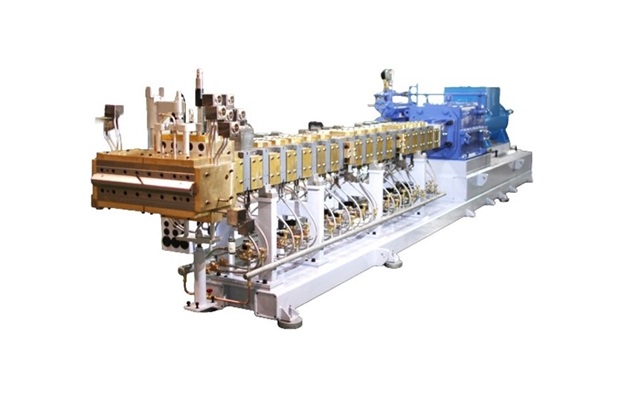
Twin Screw Extruder TEX αⅢ series used in the demonstration test
In general, heating is one way to accelerate chemical reactions. In this demonstration experiment, we used a mechanochemical reaction that can promote the reaction without relying solely on heating, by also utilizing mechanical forces such as strong mixing and friction generated by machinery. This technology is attracting attention as it can enable the reaction to proceed in a shorter time with less energy, thereby helping to reduce environmental impact.
-
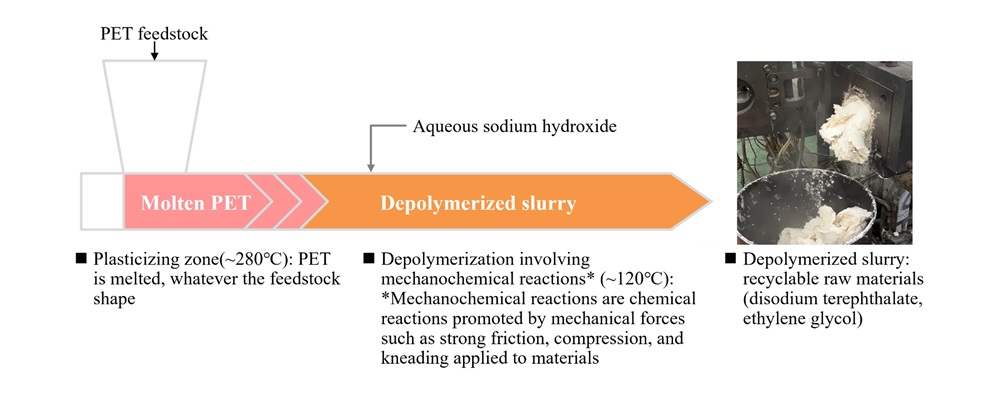
Overview of the Alkaline Depolymerization Process
Key Achievements
• Depolymerized over 95% of the PET
• Demonstrated stable operation at a throughput of 250 kg/h or greater.
• Obtained knowledge regarding equipment specifications and operating conditions required for commercial-scale plant design
These achievements established the technological foundation for commercialization, extending beyond laboratory-level validation.
Future Outlook
Building on this technology, the companies will continue developing an integrated recycling process covering the entire value chain from PET collection and depolymerization to resource recovery. They will also evaluate the applicability of the technology to a wide range of PET feedstocks, including non-food contact material grade PET materials, and accelerate efforts toward practical implementation and commercialization.
Furthermore, through collaboration with a diverse range of partners, including corporations, local governments, and research institutions, the companies will promote technology development and efforts toward practical implementation and commercialization, with the aim of advancing resource circulation and contributing to the realization of a sustainable circular economy.
About the Kirin Group’s Packaging Initiatives
In the Kirin Group Environmental Vision 2050 established in 2020, the Kirin Group set forth its goal of realizing “a society that circulates containers and packaging in a sustainable way.” In addition, under the Kirin Group Plastic Policy*6, the Group aims to increase the proportion of recycled resin used in PET bottles in Japan to 50% by 2027. The Kirin Group promotes resource circulation for containers and packaging through initiatives such as expanding the use of “R100 PET bottles” made from 100% recycled PET resin, collecting used PET bottles in cooperation with companies and municipalities, and developing and commercializing chemical recycling technologies. This initiative is part of those efforts and aims to contribute to advanced PET resource recycling and the development of a circular economy.
*6 Vision / Policies / Structure | The Environment | KIRIN - Kirin Holdings Company, Limited
JSW’s Initiatives for Plastic Resource Circulation
In this initiative, JSW leveraged the continuous processing capabilities cultivated through its Twin Screw Extruder TEX αⅢ series and conducted repeated validation studies aimed at future practical implementation and commercialization. Guided by its purpose, “Material Revolution™, making the world sustainable and prosperous,” the JSW Group contributes to realizing a plastic-resource-recycling society and a low-carbon society. As part of these efforts, its Plastics Machinery Business Division develops technologies and products that contribute to the realization of a sustainable future society.
The TEX αⅢ series is widely applied to recycling processes, including material recycling and chemical recycling, and supports plastics recycling and the reuse of various materials.
In the field of chemical recycling, JSW has already established continuous recycling technology for the continuous recovery of MMA (methyl methacrylate) monomer from used acrylic resin. Through R&D at its Hiroshima Technical Center, the company aims to further contribute to the development of plastics recycling and a sustainable society.
About Kirin Holdings
Kirin Holdings Company, Limited is a global company operating across three core business domains spanning Alcoholic Beverages, Non-alcoholic Beverages & Health Science, and Pharmaceuticals. The company traces its roots to Japan Brewery, established in 1885, which later became Kirin Brewery in 1907. Since then, Kirin has expanded its business operations by leveraging fermentation and biotechnology as core strengths. The company entered the pharmaceutical field in the 1980s, which has since grown into a global business. In 2007, the company transitioned to a pure holding company structure as Kirin Holdings, and it is now strengthening its Non-alcoholic Beverages & Health Science domain.
Under its long-term vision “Innovate2035!”, the Kirin Group is focused on creating value that encourages behavioral change among consumers and patients, creating new lifestyle habits in the areas of food and health. With a unique business portfolio spanning Alcoholic Beverages, Non-alcoholic Beverages & Health Science, and Pharmaceuticals, the Group will further expand group-wide initiatives that support both mental and physical well-being.
The Kirin Group will continue to advance innovation through the combined strength of its people and technology, creating both social and economic value as a global leader in CSV*, while pursuing sustainable, long-term growth in corporate value.
*Creating Shared Value: combined added value for consumers as well as for society at large.