[Soft drinks & Health science]
Study Suggests Lower Plasmacytoid Dendritic Cell (pDC) Activity May Be Associated With Increased Risk of Developing the Common Cold
- CSV
- Research and Technology
October 23, 2026
Kirin Holdings Company, Limited
TOKYO, October 23, 2026 - Kirin Holdings Company, Limited (Kirin Holdings), in collaboration with the National Institute of Nutrition in Vietnam, conducted a study involving 41 healthy Vietnamese medical students and found that individuals with lower plasmacytoid dendritic cell (pDC) activity at baseline may be at increased risk of developing the common cold during the subsequent four weeks. All seven participants who developed a common cold during the observation period were in the low-pDC-activity group. The study also found higher risks of fever, plugged nose, and sore throat among participants with lower pDC activity.
The findings were presented at the Annual Meeting of the Japanese Society for Clinical Immunology on October 22, 2026. The study has also been accepted for publication in the international scientific journal Tropical Medicine and Infectious Disease.*1
Upper respiratory tract infections, including the common cold, are among the most common infectious diseases worldwide and impose a substantial burden on society through reduced quality of life and lost productivity. However, despite considerable variation in susceptibility among individuals, methods for assessing infection risk based on pre-infection immune function have not yet been fully established.
In this study, we focused on plasmacytoid dendritic cells (pDCs), which play a critical role in antiviral immunity.
Specifically, we examined the association between IFN-α*2 production capacity, a surrogate marker of pDC activity, and subsequent susceptibility to the common cold. These findings may contribute to the development of personalized infection-prevention strategies based on an individual's immune status and risk profile.
*1 Association Between TLR9-Mediated Interferon-Alpha Production and Short-Term Risk of Common Cold: A Pilot Observational Study
*2 Interferon-alpha (IFN-α), a type I interferon with antiviral activity.
Background and Objectives
Upper respiratory tract infections such as the common cold are generally self-limiting; however, they place a burden on both individuals and society through reduced quality of life and absenteeism from work or school. Furthermore, although susceptibility to infectious diseases varies considerably among individuals even under similar living conditions, validated methods for predicting individual susceptibility before infection remain limited.
Plasmacytoid dendritic cells (pDCs) are immune cells that play a central role in antiviral immunity and are the principal producers of type I interferons, including IFN-α. Despite their importance in host defense against viral infections, evidence linking individual differences in pDC function to subsequent risk of developing the common cold remains limited.
Therefore, we investigated whether IFN-α production induced by a TLR9 agonist at baseline, used as a functional surrogate marker of pDC activity, was associated with the occurrence of the common cold during the subsequent four-week observation period.
Study Design and Methods
This prospective observational analysis*3 utilized data obtained from participants in the placebo arm of a previous clinical study involving healthy medical students in Vietnam. The present analysis included 41 participants for whom both baseline IFN-α production data and information on common cold incidence during the observation period were available.
Peripheral blood mononuclear cells (PBMCs)*4 were isolated from blood samples collected at baseline. The cells were stimulated with CpG oligodeoxynucleotide (CpG ODN)*5, a TLR9 agonist that mimics microbial DNA signals, and IFN-α production was measured after 24 hours of culture.
Participants were then classified according to the amount of IFN-α produced into a HIGH group (n = 20) and a LOW group (n = 21), based on the median IFN-α production level.*6
During the four-week observation period, participants recorded their body temperature and seven cold-related symptoms daily: runny nose, plugged nose, sneezing, sore throat, cough, head congestion, and fatigue. A common cold event was defined*7 as the presence of fever (≥37.5°C) together with a symptom score exceeding a predefined threshold.
Associations between baseline pDC activity and subsequent occurrence of the common cold and individual cold symptoms were analyzed.
Importantly, under the stimulation conditions used in this study, intracellular staining confirmed that the vast majority of IFN-α-producing cells within PBMCs were pDCs (mean: 97.2%).
*3 Secondary analysis of data collected in the previous study: Effects of Lactococcus lactis Strain Plasma (LC-Plasma) Intake on Infection-Related Symptoms Among Healthcare Workers: A Randomized, Double-Blind, Placebo-Controlled Study
*4 A collective term for immune cells circulating in the blood, including pDCs and lymphocytes.
*5 A synthetic DNA sequence that mimics characteristic microbial DNA motifs recognized by TLR9.
*6 Participants were classified into HIGH and LOW groups using the median baseline IFN-α production level.
*7 Based on the definition used in: Randomized Controlled Trial of Nasal Thermotherapy for the Treatment of the Common Cold: A Feasibility Study | BMJ Open
Key Findings
1. Participants with lower pDC activity showed a higher risk of developing the common cold
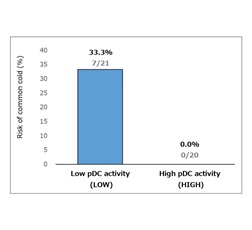
During the four-week observation period, seven of the 21 participants in the LOW group developed a common cold, whereas no cases were observed among the 20 participants in the HIGH group. The risk of developing a common cold was higher in the LOW group.
-
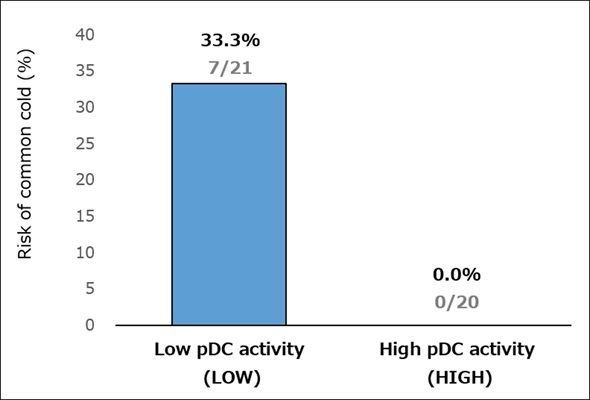
Figure 1. Cumulative Incidence of the Common Cold During the Four-Week Observation Period
2. Higher risks of fever, plugged nose, and sore throat were observed in the LOW group
Participants in the LOW group also exhibited higher risks of fever (≥37.5°C), plugged nose, and sore throat compared with those in the HIGH group.
-
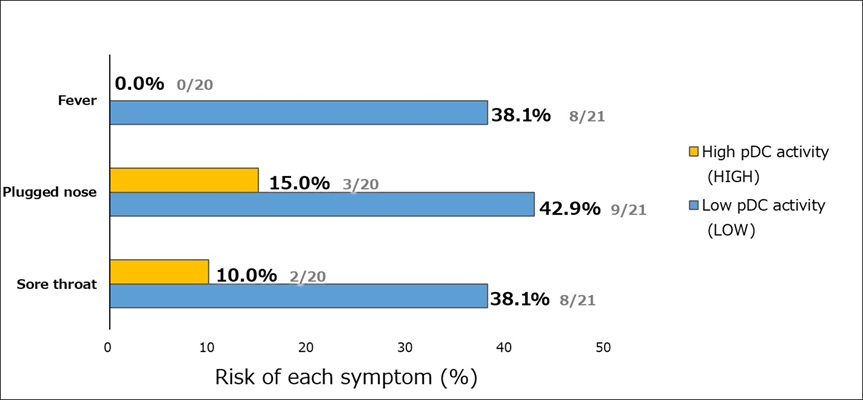
Figure 2. Incidence of Common Cold Symptoms in the HIGH and LOW Groups
Significance of the Findings
A key strength of this study is its prospective design, which enabled evaluation of the association between IFN-α production capacity measured before the observation period and subsequent occurrence of the common cold.
The findings suggest that individuals with lower pDC activity, as reflected by reduced IFN-α production capacity, may be more susceptible to upper respiratory tract infections, including the common cold, over the short term. These results provide further evidence linking innate immune function to individual differences in susceptibility to respiratory infections.
Future Outlook
Future studies will expand both the study population and observation period to further investigate the relationship between innate immune functions, including pDC activity and type I interferon responses, and susceptibility to infectious diseases. These findings may contribute to the development of personalized infection-prevention approaches and improved immune health management.
About Kirin Holdings
Kirin Holdings Company, Limited is a global company operating across three core business domains spanning Alcoholic Beverages, Non-alcoholic Beverages & Health Science, and Pharmaceuticals. The company traces its roots to Japan Brewery, established in 1885, which later became Kirin Brewery in 1907. Since then, Kirin has expanded its business operations by leveraging fermentation and biotechnology as core strengths. The company entered the pharmaceutical field in the 1980s, which has since grown into a global business. In 2007, the company transitioned to a pure holding company structure as Kirin Holdings, and it is now strengthening its Non-alcoholic Beverages & Health Science domain.
Under its long-term vision “Innovate2035!”, the Kirin Group is focused on creating value that encourage behavioral change among consumers and patients, creating new lifestyle habits in the areas of food and health. With a unique business portfolio spanning Alcoholic Beverages, Non-alcoholic Beverages & Health Science, and Pharmaceuticals, the Group will further expand group-wide initiatives that support both mental and physical well-being.
The Kirin Group will continue to advance innovation through the combined strength of its people and technology, creating both social and economic value as a global leader in CSV*, while pursuing sustainable, long-term growth in corporate value.
*Creating Shared Value: combined added value for consumers as well as for society at large.