

Initiatives to Promote Equity & Inclusion and Increase Diversity
Initiatives to Promote Equity & Inclusion - Eliminate barriers that prevent a diverse workforce from playing an active role & Accept and make the most of diverse viewpoints/values
Nari-Kirin Training
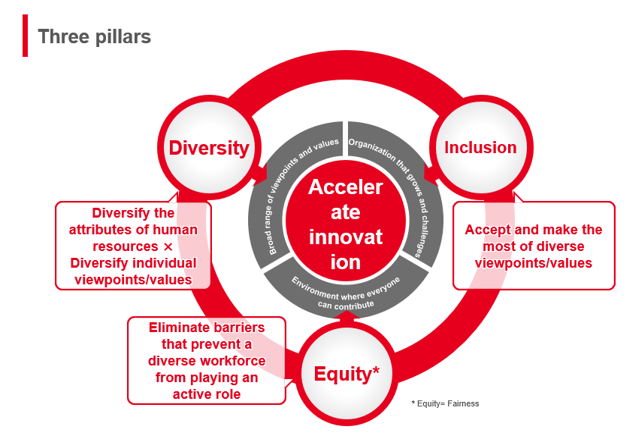
The Nari-Kirin Training program allows participants to experience diverse perspectives and approaches to work.
It is widely implemented throughout the Kirin Group as an initiative that supports all aspects of DEI. It promotes diversifying individual values and viewpoints, eliminates barriers that hinder the success of diverse talents, and embraces diverse perspectives to leverage their differences.
Originally suggested by employees, this training has become a key initiative in supporting the Kirin Group’s work-life balance effort, and contributes to fostering a workplace where everyone can work comfortably.
How the Nari-Kirin Training Started
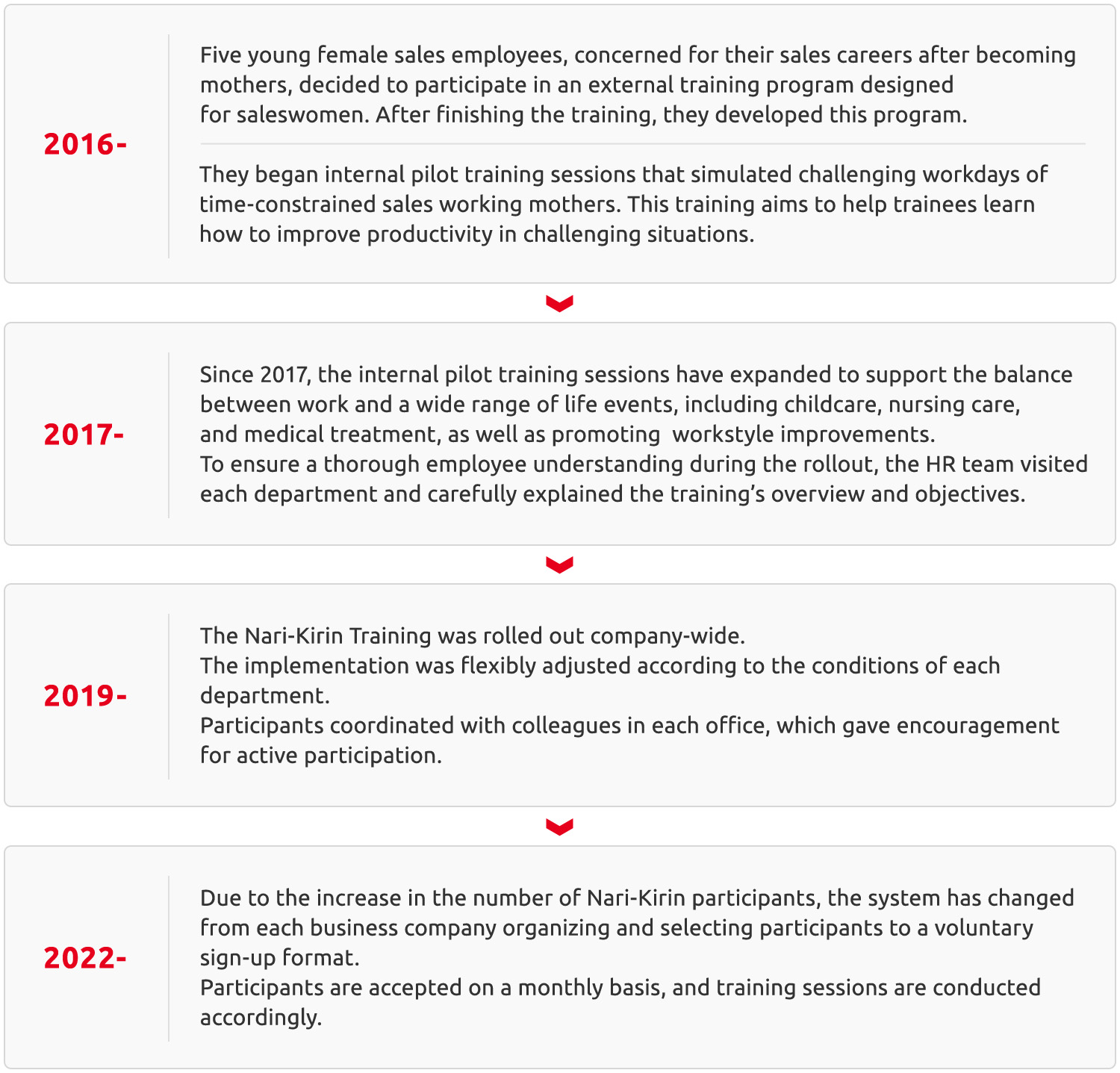
The Nari-Kirin Training was created by five young female sales employees. After conducting multiple pilot training sessions, they carried out a trial within the company.
The training’s originality and effectiveness were highly recognized, and since 2019 it has been implemented across the entire Kirin Group.
Overview of the Nari-Kirin Training
The Nari-Kirin Training allows participants to experience simulated lifestyles of people balancing various life circumstances, such as parents managing childcare and household tasks, caregivers, and those caring for sick family members. Through the experience, the training aims to:
-
Foster understanding of various life circumstances and work styles to create a more inclusive and comfortable working environment for everyone.
-
Encourage participants to review and improve their work styles.
-
Enhance the managerial skills of supervisors.
This training delivers various positive outcomes and can also be used as a rehearsal for real-life situations requiring support.
The Nari-Kirin Training was given to a wide range of employees regardless of gender or employment type, spreading awareness of work-life balance support throughout the entire group.
What to Expect During Nari-Kirin Training (Childcare Edition)
While participating in the Nari-Kirin Training, participants may receive random calls about once or twice a month from locations related to participant-chosen settings, such as daycare centers or hospitals.
In such cases, participants must immediately hand over their work to the team and leave the office. After leaving, they are free to use the time to broaden their personal interests.

Scenes during Nari-Kirin Training
For an employee to balance their work and life, it is essential to have the understanding and cooperation of supervisors and colleagues.
Therefore, during the Nari-Kirin Training, participants need to disclose their participation in training to their colleagues and supervisors, thus the training also promotes support from those around them.
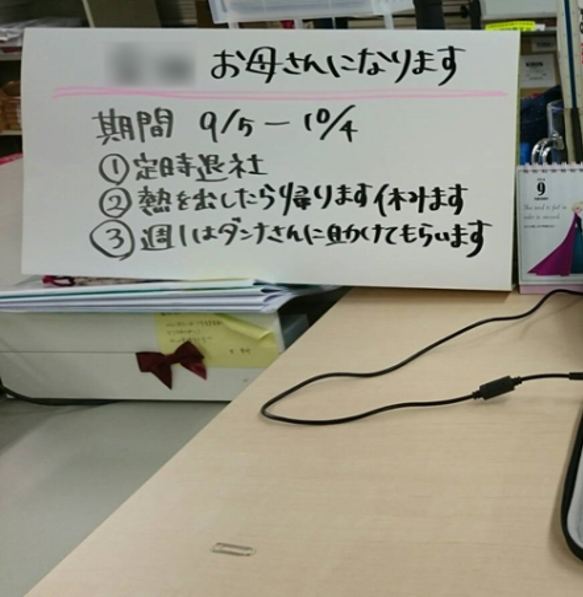
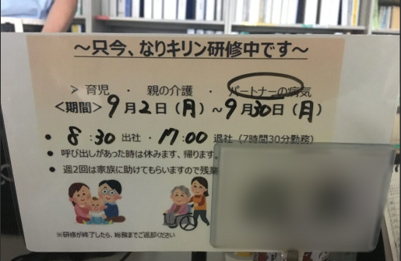
*The photo showing that they are notifying others that they are currently participating in the Nari‑Kirin Training.
Effects of the Nari-Kirin Training
The Nari-Kirin Training is effective not only in supporting work-life balance, but also in various aspects such as reviewing work styles, improving teamwork, and promoting motivation and job satisfaction.
A particularly notable feature is that it brings about changes and awareness not only to the participants themselves but also to those around them.
Below, we introduce the effects of the training along with feedback from the participants.
①Increased men's willingness to participate in housework and childcare
Participants feedback
-
I was glad to be able to do some housework such as cooking dinner for my working wife.
-
I was able to do things I usually can’t, like taking my child to and from cram school.
-
I have more time to play with my child at night.
-
Conversations with my child have increased.
②Enhanced understanding of working with time constraints
Participants feedback
-
I appreciate the support received after those surprise calls. If I encounter a similar situation, I want to support my colleagues as well.
-
I realized for the first time how stressful it is to leave work at the same time every day.
-
It’s possible to keep regular work hours if you try.
③Improvement in teamwork
Participants feedback
-
I was also able to disclose my situation, such as having daily childcare duties or providing nursing care.
-
We were able to foster supportive relationships with our teammates; we can request help and support easily now.
-
Delegation of authority to colleagues has been smooth.
④ Accelerated a job satisfaction improvement
Participants feedback
-
I believe that teammates felt easy leaving early because I, a team leader, left early sometime.
-
The mood to promote motivation and job satisfaction has increased.
-
Although we have been streamlining work processes, I realized that there is still room for improvement.
⑤Changes in work style and fostering awareness
Participants feedback
-
I have become more conscious of sharing my work details regularly.
-
I felt the need to consider developing people who can provide support in emergencies.
-
I have a bad habit of worrying, but by consulting with my team, my productivity improved.
Usage of the Nari-Kirin Training Beyond the Company
The Nari-Kirin Training has been regarded highly by society and has expanded nationwide.
~Case 1~
In 2018, in Tottori Prefecture, a program called "Don't Panic with Nursing Care or Childcare! Family Boss Practice Project," based on Nari-Kirin, was launched to create a system that allows employees, colleagues, supervisors, and companies to respond flexibly without panic when employees face work restrictions due to nursing care or childcare.
~Case 2~
Following the comprehensive partnership agreement signed in 2018 between Kirin and Kobe City, the city introduced and implemented the KOBE TIME TRIAL – Childcare Edition training program, also based on Nari-Kirin. This program aims at improving work productivity.

~Case 3~
In 2019, Hiroshima Prefecture and Kirin signed an agreement to promote women's active participation in society. The two parties collaborated to share know-how on creating adequate working environments where employees can manage childcare or nursing care without stress. The two parties also agreed to share expertise related to the Nari-Kirin Training.
The initiative also shared an overview of the training with various companies, which also began to include training into their efforts.
Initiatives to Promote Equity - Eliminate barriers that prevent a diverse workforce from playing an active role
Initiatives for Work-life Balance Support
The Kirin Group embraces CSV (Creating Shared Value) management and aims to become an innovative organization in which every employee adds something new through their work—“Better Today Than Yesterday, Better Tomorrow Than Today.” Achieving this vision requires a strong foundation of harmony between work and life.
We believe it is the company’s responsibility to create a workplace where no one has to give up on opportunities to thrive because of challenges in balancing work and life. We therefore position work-life balance support as a key Equity initiative that removes barriers and enables diverse talent to thrive. Through support systems, training, seminars, and initiatives to improve working practices, we help employees balance their work with childcare, caregiving, medical treatment, and other life events.
Remote Work Program Without Relocation
This program was established to address the concerns employees may face when a job-related relocation could affect their family or personal circumstances, particularly when they have childcare or caregiving responsibilities. Such concerns can become barriers to positive career development and the ability to perform proactively and to their full potential.
Under specified conditions, the program allows eligible employees—including those raising children or caring for family members—to work from a location away from their assigned workplace without relocating. Through this program, we aim to create an environment in which employees can balance their work and personal responsibilities while continuing to develop their careers.
The WA Salon for Work-Life Balance
Initially, the program focused primarily on seminars about balancing childcare and work. It was later expanded to include balancing caregiving and work. In response to changes in society and evolving employee needs, we are now broadening opportunities to share knowledge and experiences and to seek advice on balancing work with childcare, caregiving, medical treatment, and other life events.
Going forward, we will further expand initiatives covering a wide range of life events and strengthen our support systems so that diverse talent can continue to thrive throughout different stages of life.
The name “WA Salon for Work-Life Balance” reflects our aspiration to create a circle of mutual support in which everyone—regardless of position or role—views work-life balance as a shared concern and supports one another in a spirit of “we’re all in this together.”
-
In Japanese, “WA” also represents three concepts:
和 (WA — Harmony): Creating harmony between work and life
話 (WA — Dialogue): Talking openly about balancing work and life
輪 (WA — Circle): Widening the circle of connections and mutual support between people
Initiatives to Change Consciousness(Organization-wide Approach)
Unconscious Bias Training
The Kirin Group addresses unconscious bias, highlighting the disparities in awareness among people.
Specifically, we provide trainings designed to help participants recognize and understand their own unconscious biases, gain knowledge and insights, and develop good behavioral habits. This prevents such biased stereotypes from hindering co-creation among employees.
Initiatives to Promote Inclusion - Accept and make the most of diverse viewpoints/values
The Kirin Group believes that inclusion is a prerequisite for diverse talent to thrive within the organization and a driver of innovation. Based on this belief, we are committed to creating a psychologically safe workplace, which highlights inclusion.
Initiatives to Create a Psychologically Safe Organization
Psychological Safety Training
To build a shared understanding of psychological safety throughout the Kirin Group and promote constructive dialogue and healthy debate among team members, we provide training that equips employees with foundational knowledge and helps translate that understanding into actions that foster psychologically safe workplaces.
Since 2025, we have offered role-specific training programs for leaders and team members to cultivate an organizational culture in which diverse perspectives are respected and people can engage in candid, constructive dialogue.
-
*Other DEI initiatives are also included as important efforts on the websites of Kirin’s group companies and overseas subsidiaries.
Kyowa Kirin:Diversity, Equity & Inclusion|Strengthen human resources and infrastructure to realize life-changing value|Kyowa Kirin
FANCL:A Future with Diverse Human Resources | Sustainability | FANCL
LION:Win at Work and Life with Lion (lioncareers.com)
Initiatives to Increase Diversity
A Hierarchical Approach to Embracing Diversity and Differences to Foster Value Creation
Promoting diversity is not just an issue for the headquarters or diversity promotion departments but a company-wide management challenge.
The management team actively communicates to instill the principles both internally and externally. The company has also established a company-wide system for HR evaluation, talent development and training, and recognition to help drive behavioral and awareness reforms from the management level to general employees.
| Hierarchy | Initiatives (Examples) |
|---|---|
| Executive Management |
|
| Leaders (Managers) |
|
| Members (General Employees) |
|
| Cross-Hierarchy Initiatives |
|